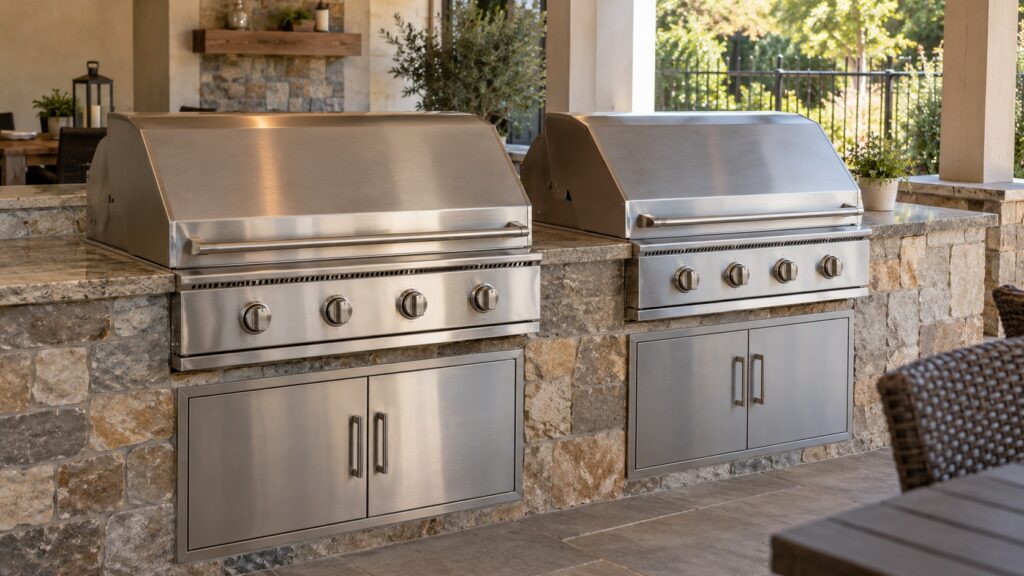
If you are weighing a DCS grill vs Lynx, the honest answer is that the brand name should be the last thing you compare. DCS grills come as built-in and cart models, and the right grill for you, whichever maker you choose, depends on how you cook, how the grill will be installed and who will look after it. We are an independent repair company, and our pages describe DCS grills, so we cannot rate another maker’s grill on features we have not documented. What we can do is give you the questions to ask about either grill, and show where to find the answers for the DCS models on our site. Bring the same list to every showroom and every spec sheet, and the comparison will take care of itself.
How should you compare a DCS grill vs Lynx?
Start with the installation, not the badge. Decide whether the grill will be built into an island or stand on a cart, how wide the space is and whether a gas line is available. Those three answers remove most of the choices before a brand is mentioned. Then compare the features that you will use: how many burners the grill has and how they are laid out, whether you want a rotisserie, a side burner or lighting, and what the grates are made of. Look at each maker’s own model page and the installation sheet for the exact model, because a brand-level impression does not tell you what a specific grill includes.
Our own pages describe the DCS side. The guide on DCS Series 7 versus Series 9 grills explains how the families are described, and the guide on 30, 36 and 48 inch grills covers width. For the other grill, use the same checklist and the maker’s own literature.
Which questions matter more than the brand?
Ask about fuel first. A grill is built and set up for natural gas or for propane, and swapping fuels is not a casual job. Our natural gas versus propane guide explains why, and it is true for any maker’s grill. Ask whether the model you are looking at is sold in the fuel you need.
Ask about heat: where the burners sit, how the heat spreads across the grates and whether any part of the grill, such as a rotisserie burner, is a separate system. Ask about cleanup: how easily the grates, the burners and the grease tray can be taken out and cleaned. Ask about ignition: how the burners are lit and whether each burner has its own igniter. These are questions about design, and the answers are on each model’s page and manual.
What about materials and build?
Stainless steel is common on premium grills, but the grade, the thickness and the finish differ from model to model, and a brochure word like heavy-duty does not tell you much. If the maker lists the steel grade for the parts that matter, such as the burners, the grates and the hood, compare those parts. If a list does not exist, ask. Look at the grill in person if you can: check how the lid closes, how the knobs turn and whether the cooking grates feel solid. Check how the grill is meant to be cleaned, because the best material is the one you are willing to look after.
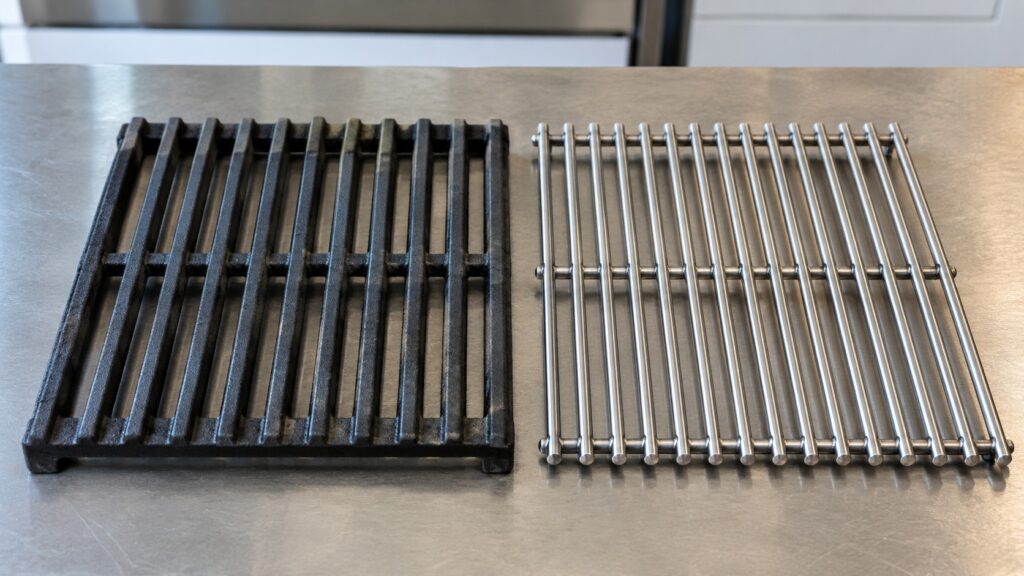
Cast iron grates hold heat and sear well but need care to avoid rust, and stainless grates are easier to clean and wear differently. Which suits you depends on how you cook and how much care you will give them. Our guide to grill grate maintenance shows what each routine involves.
What about service, parts and warranty?
A grill is outdoors, and weather and grease are hard on it. The long-term cost of a grill depends as much on whether you can get it serviced and sourced for parts as on the price on the day. Ask who services the grill in your area, whether replacement burners, igniters and grates are available for the model and what the warranty covers and for how long. Our page on DCS warranty coverage explains the DCS side, and any other maker will have an equivalent. Do not rely on a forum comparison or on a single review; ask for the details in writing.
Be wary of any article, including this one, that claims one grill beats another in reliability without data from your own conditions. Climate, fuel, how often you cook and how you clean all change the result.
How do you decide?
Write down the fuel, the width, the installation type and the three features you really use. Compare the exact models that satisfy those four things, and then compare how each maker supports them. If two grills both fit, the one with easier cleanup and a service path you trust is the better choice. If you already own a DCS grill and a part is failing, our grill repair versus replace guide helps you decide whether to fix it. We are an independent repair company, not the manufacturer. Our grill repair page explains how a visit works, and you can schedule a visit online.
Gas connections and fuel conversions are work for a qualified gas professional, whichever grill you choose. If you ever smell gas, do not switch anything on or off, leave the area and call the gas company or 911 from outside.