How DCS grills are built
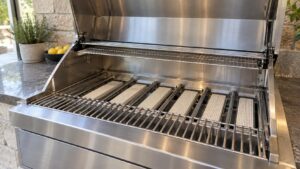
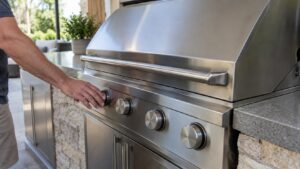
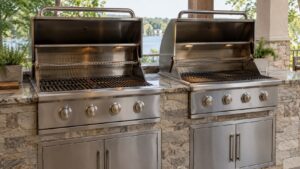
Professional DCS grill repair starts with the engineering behind these flagship outdoor gas grills. DCS, a Fisher & Paykel company, builds its Series 7 and Series 9 grills in 30″, 36″, and 48″ widths from 304-grade stainless steel, in both built-in and freestanding cart formats. The heart of the grill is a set of U-shaped 304-stainless burners rated around 25,000 BTU each, paired with Ceramic Radiant Glow rods that spread heat evenly and let the grill range from a gentle 300°F up to a searing 1,100°F. Higher models add a Grill Tower, an integrated rotisserie with a rear infrared burner, and a Grease Management System. Fuel suffixes tell the configuration: N for natural gas, L for liquid propane, across the BGB, BGC, BFG, BH1, and BE1 model families.
Burners, ignition, and outdoor exposure
Each U-burner is fed through a valve and lit by an electronic or battery push-button igniter; on propane units a regulator manages tank pressure and can drop into a safety bypass if a valve is opened too quickly. DCS grills are mechanical appliances — they have no digital error codes — so every problem shows up as a symptom: a burner that won’t ignite, low heat on sear, a yellow flame, or frequent flare-ups. Outdoor exposure adds its own failure modes, with moisture in the ignition wiring, spiders nesting in the venturi tubes, and grease corrosion on the burners. Because there is no code to read, diagnosis is hands-on: checking ports, electrodes, regulator behavior, and the Grease Management System. Our grill symptom guides cover each one.
Common DCS grill repair problems
The most frequent grill calls involve a burner that clicks but won’t ignite, low heat that never reaches sear temperature, a yellow or lazy flame, uneven heat across the grates, a rotisserie burner that won’t light, and frequent flare-ups. A burner that won’t ignite is usually a clogged port set, a corroded electrode, a depleted igniter battery, or moisture after weather exposure. Low heat on all burners after connecting a propane tank typically means the regulator has gone into bypass and simply needs to be reset by closing the valves and tank, then re-opening slowly. Flare-ups point to a clogged Grease Management System or a missing grease tray. Rusted-through U-burners are replaced with the correct OEM part for the series. Most DCS grill repair jobs are resolved in a single visit once the burner, igniter, or regulator responsible is identified.
Outdoor maintenance that prevents grill repairs
Because a DCS grill lives outdoors, seasonal maintenance prevents most of the problems that bring one in for service. Burning the grill at high heat for a few minutes after cooking and brushing the grates keeps grease from carbonizing, while emptying the Grease Management System tray regularly is the single best way to avoid flare-ups. Inspecting the U-burners for spider nests or debris in the venturi each spring keeps the flame blue and the heat even, and checking the igniter battery and drying the ignition wiring after wet weather prevents the no-ignition calls common after winter storage. A weatherproof cover and an occasional wipe-down of the 304-stainless surfaces slow the corrosion that eventually burns through a burner. Our model pages for builds such as BGB30-BQR list the matching U-burners, radiants, and rotisserie parts.
Service, parts, and warranty
Repairs use genuine OEM U-burners, igniters, radiant rods, regulators, and rotisserie components matched to the Series 7 or Series 9 model. Our certified technicians cover all 50 states and 120+ metro areas, and the booking form accepts requests 24/7, with same-day visits where availability allows. Diagnostic visits start from $129; the final cost depends on the parts and grill configuration involved. Specifications and the full grill lineup are published by the manufacturer at dcsappliances.com. If your outdoor kitchen also has a vent hood or refrigeration, see our full services overview.