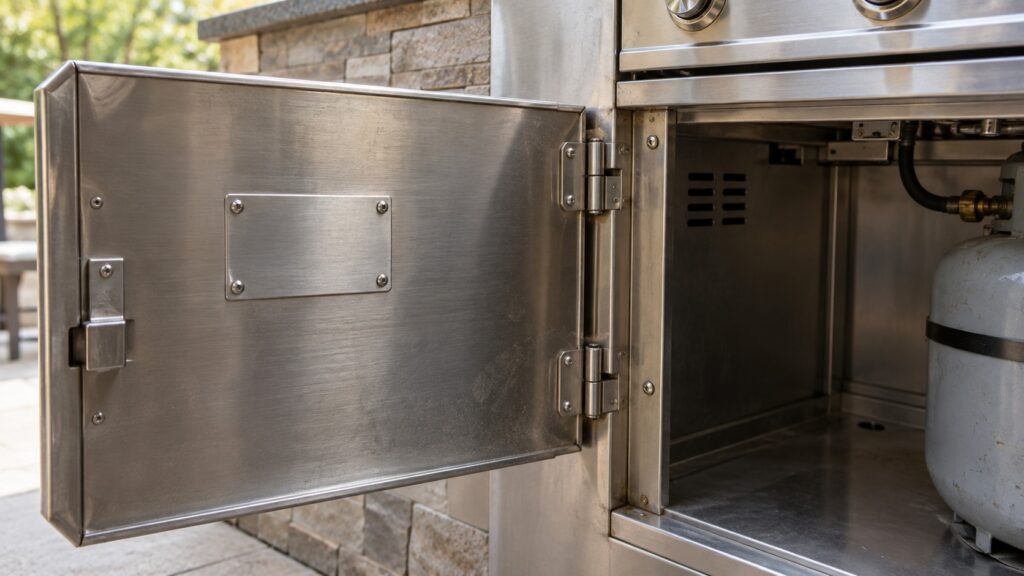
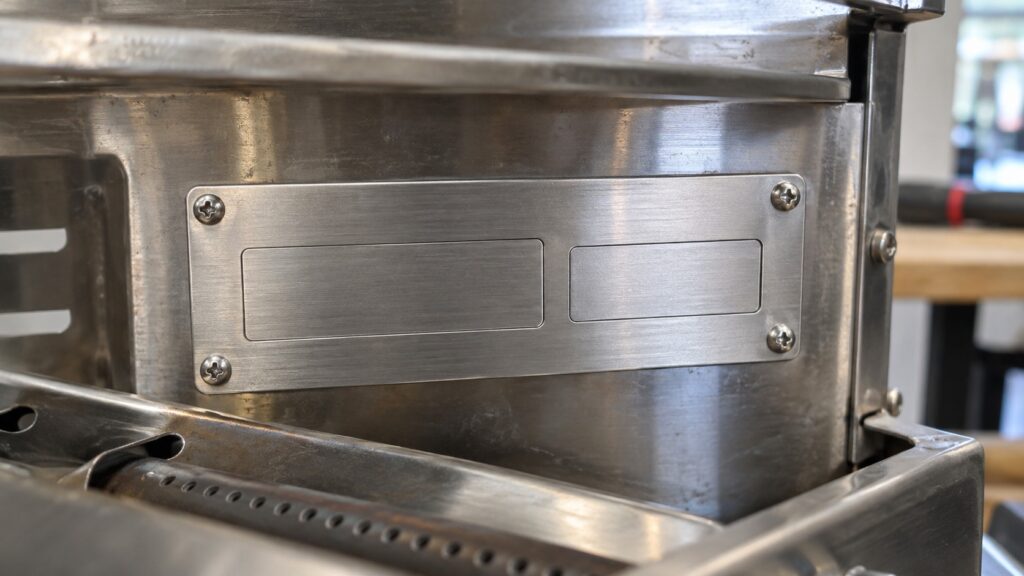
Your DCS grill model number is on a metal rating plate, and on a built-in head it is almost always in one of three places: on the inside face of the access door below the grill, on the underside of the control panel behind the knobs, or on the back of the head where it faces into the island. Find it before you order anything, because the series letters at the front of that number and the suffix at the end of it decide which grates, which burners and which conversion kit will fit.
Where is the rating plate on a DCS grill?
Start with the access door. On a built-in head, open the door or drawer below the cooking surface and look at the inside face and the frame around it — the plate is usually riveted flat where it stays dry. On a cart model, look on the back of the head first, then inside the cart doors.
If the plate is not there, take the knobs off and look up under the control panel, and check the back of the head where it faces the island cavity. On an island installation that last position can be unreachable without pulling the head, which is precisely why it is worth writing the number down once and keeping it somewhere you will find it again.
When the plate is unreadable — and outdoors they do corrode — the packing list, the original invoice and the gas fitter’s paperwork are all places the number survives. So is the permit file for the outdoor kitchen, if the island was built under one.
What do the series letters mean?
They identify the family, and families are the level at which most parts are shared. Grills across the range carry prefixes such as BGB and BGC, later heads use BFG, and built-in and hybrid units appear as BE1 and BH1. Two heads that look almost identical in an island can belong to different series and take different burners, which is the single most common cause of an ordered part not fitting.
Series also tells you roughly where a grill sits in time, which matters for availability. Parts for current series come off a shelf; parts for an older series come from a specialist, and some are gone. That is worth knowing before spending an afternoon on a repair, and our DCS parts guide covers how to source for an older unit.
What does the width number change?
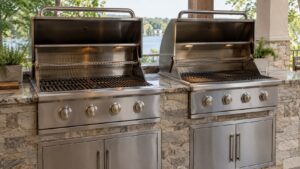
More than size. Width sets the number of main burners, and burner count sets what the grill can actually do — a 30 inch head with two burners has no true indirect zone, while a 36 inch head with three does. Width also sets the cut-out, and cut-outs are the reason a replacement head is not simply a matter of picking the same width: openings have shifted between generations, and a 36 inch head from one series may need the stone altered to accept a 36 inch head from another.
Measure the opening rather than trusting the number when you are planning a swap. A tape measure across the existing cut-out, plus the model number of what is in it, is the whole specification a supplier needs.
Why does the fuel suffix matter so much?
Because it is not a setting. A trailing L is propane and a trailing N is natural gas, and the difference lives in the orifices behind the valves and in the regulator. Propane runs at higher pressure through smaller orifices; natural gas needs larger ones. Put one on the other’s supply and you get either lazy yellow flames that soot everything, or a flame far bigger than the burner was built for.
Conversion is possible on many units with the correct kit and a qualified technician, and it is never a matter of drilling out a part. Our guide on natural gas against propane covers the trade and what a proper conversion involves.
What should you write down, and where?
- The full model number exactly as printed, including the suffix letters most people drop.
- The serial number, which separates running changes inside one series.
- The fuel the unit is actually connected to today, which is not always what it left the factory as.
- The cut-out dimensions for a built-in head, measured once while you have the tape out.
- A photo of the plate in your phone. It outlives the plate, which will corrode.
Do the same for the other appliances in the island while you are there. Outdoor refrigerators carry an RF24 style number on a plate inside the cabinet, and knowing it turns a vague call about ice into an exact one.
How does the number change what you buy?
Grates are the clearest case. Cast iron and stainless grates are sized to a specific head and a specific generation, so a grate ordered by width alone frequently arrives a half inch out and sits proud of the frame — our grate maintenance guide covers what a correct grate should look like in place. Burners are the same story, with the added complication that a burner must match both the head and the fuel.
Ignition parts, valves and side burner components follow the same rule. A side burner in particular is often a different generation from the grill next to it, because it was added or replaced separately, so check its plate rather than assuming — see our guide on repairing or replacing a DCS side burner.
When to call a technician
Call when the plate is gone and the unit needs parts, when a fuel conversion is being considered, or when a replacement head has to be fitted into an existing island and connected to the existing gas run. Identifying an unmarked grill from its burner layout and valve pattern is routine for someone who sees these every week, and gas work belongs with a licensed technician in any case.
We are an independent repair company, not a factory service arm. Pricing starts from a diagnostic visit and we confirm the estimate before any work begins. DCS grill repair covers burners, grates, ignition and valves across the older series as well as current ones, and you can schedule a visit online or call 1-844-487-0065.