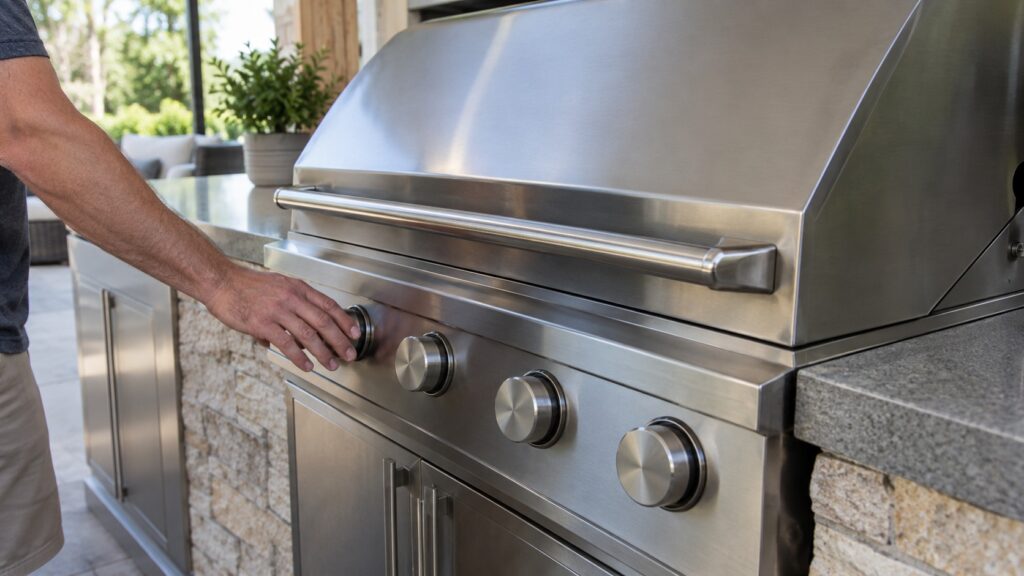
A DCS grill ignition system is a small spark circuit built around each burner: a power source or switch sends a pulse down an insulated wire to an electrode, and the spark jumps a short air gap to the grounded burner while gas is flowing. If the spark and the gas meet in that gap, the burner lights and the flame travels along the burner and across to its neighbors. Almost every “my DCS grill won’t ignite” complaint comes down to one of those two halves failing: no usable spark, or no gas in the gap at the moment of the spark.
What does the ignition system on a DCS grill actually do?
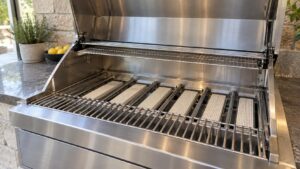
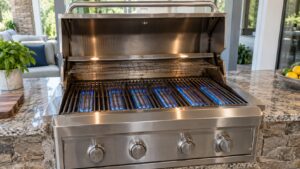
It does one thing: it creates a spark where the gas comes out. A DCS grill head has gas valves behind the control panel, a burner (the heavy U-shaped burner on Series 7 grills, as described in our U-shaped burner glossary), and a spark electrode placed a short distance from the burner. Turning a knob opens the valve for that burner and, depending on the model, also triggers the spark. Because the spark system and the gas system are separate, a grill can click all day with no flame, or have gas flowing with no spark. The two symptoms point in opposite directions.
The exact way your model starts, including whether the knob must be pushed in, held or turned to a particular position, differs by series and fuel type. Follow the lighting instructions in your owner’s manual for the model on your rating plate; this guide explains how the system works, not a lighting procedure.
Why does a DCS grill click but not light?
Clicking is the sound of the spark source doing its job, so a click only proves the pulse was created. What matters is whether it reached the gap. Three ordinary causes explain most outdoor cases. Moisture is the first: rain, hose spray from washing the island, or heavy morning dew leaves a film over the ceramic insulator, and the pulse follows the film to metal instead of jumping the gap. Grease and carbon are the second, because baked-on residue conducts electricity and gives the spark an easier path than the gap itself. A cracked insulator is the third, usually from a dropped grate or an over-eager scrubbing.
Our DCS grill igniter troubleshooting guide goes through the clicking, no-spark and no-flame cases in more detail, and the igniter keeps clicking page covers the case where the clicking never stops.
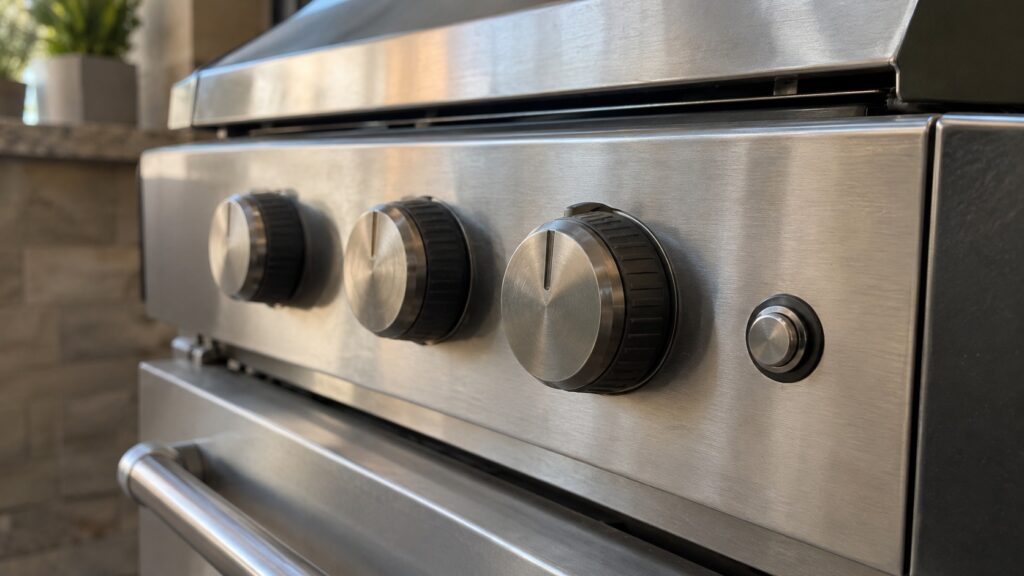
Does the burner have to be in the right place for the spark to work?
Yes. The burner is part of the circuit, because the spark needs a grounded metal surface to jump to, and the burner is that surface. A burner that has been lifted out for cleaning and put back slightly off its seat can sit too far from the electrode, or fail to make solid metal contact, and the grill will click with no flame even though nothing is broken. The same is true if the burner was knocked sideways during a cleaning pass. If you recently cleaned the grill, the first thing to check is that each burner is seated the way it was before you lifted it. Our burner cleaning guide shows how to reseat burners over the igniter electrode when you are done.
What happens after the burner lights?
Once one burner is burning, the flame does not need the spark any more. Crossover paths between burners carry the flame along, and the other burners light from their neighbors. That is why one burner that never lights while the rest are fine usually has its own problem, such as a clogged port, a blocked venturi or an electrode that has drifted, rather than a dead spark source for the whole grill. A flame that lights and then dies as soon as you release the knob is a different story again, and belongs with the valve and flame-sensing side of the grill, which is a technician’s job.
It also helps to know that the grill head, not the cart or island, holds all of this hardware; our grill head glossary lists what is included in the head.
What can you safely check yourself?
Keep to the outside of the grill, with every knob off and the grill cool. Look at the electrode area through the burner box with a flashlight: it should be dry, free of grease, and the white ceramic should be uncracked. Wipe light grease with a dry cloth, never with water sprayed into the box. Let the grill dry out if it has been rained on or washed. Check that the burners and grates are seated flat. If your model uses a battery for the spark, replace it according to the manual. Confirm that the gas supply is on and, on a propane model, that there is fuel in the tank, as your owner’s manual describes.
Do not remove control panels, bend or file the electrode, or open the gas valve assembly. Do not hunt for a gas leak with a flame, and do not light a burner with a match unless your manual describes that as an approved step for your model. If you smell gas at any point, do not turn anything on or off, keep every flame and spark source away, leave the area and call your gas company or 911 from a safe distance. Our DCS gas smell safety steps page explains the general steps.
When is it time to call a technician?
Call when the electrode is cracked, when a burner will not light even though it is clean, dry and seated, when the grill clicks continuously, when the flame is yellow or lazy after a cleaning, or when anything about the gas valves or wiring looks wrong. Replacing an electrode or a spark module is a small job for a technician, but working on gas valves and connections is not something to do at home. Our DCS grill repair page explains how a visit works, and the burner won’t ignite page lists the symptoms we see most.