A DCS side burner is worth repairing far more often than it is worth replacing, because the parts that fail on it — the burner cap, the burner head, the electrode and the grate — are consumables, while the part that would force a replacement, the valve body welded to the gas manifold, almost never fails. The decision turns on one question: is the damage above the valve, or at it? Everything above the valve is a part. The valve, on a built-in side burner, is a bigger job than the burner is worth on its own.
What exactly is a DCS side burner, and is it part of the grill?
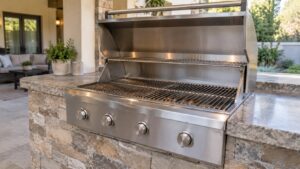
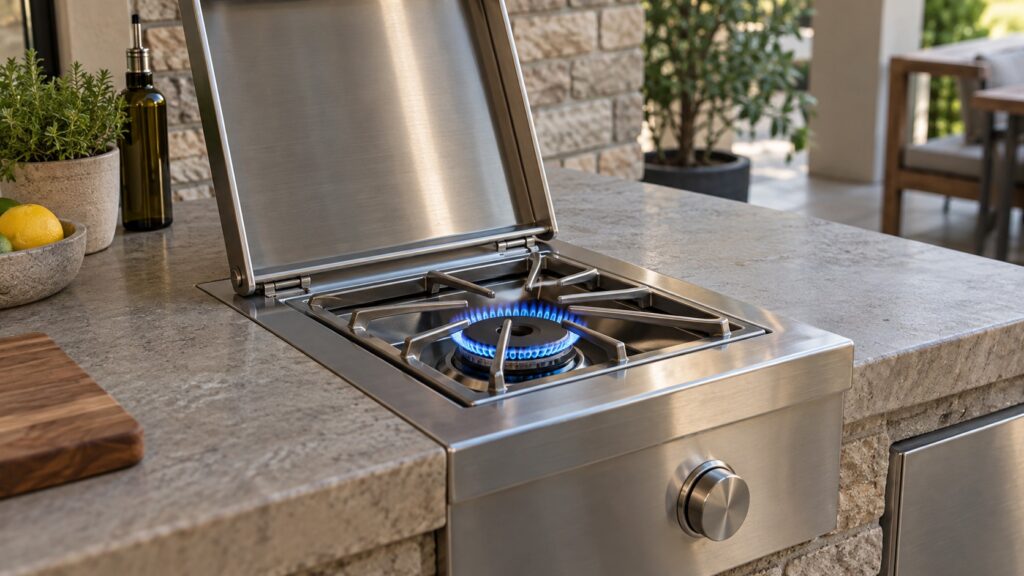
It is a separate appliance that happens to share an island with a grill. A side burner has its own gas connection, its own valve, its own ignition and its own housing, dropped into its own cut-out in the counter. That distinction matters for a repair decision, because the side burner is explicitly not part of the grill head — our grill head glossary draws the same line, and it means a side burner can be repaired, replaced or removed without touching the grill beside it.
It also means the side burner ages differently. It sits under a lid at counter height, it collects rainwater when the lid is left up, and it is used a fraction as often as the grill. Long idle periods in a wet environment are exactly the conditions that corrode a burner head, so a side burner often looks worse than the grill that gets used every weekend.
What fails first on a side burner?
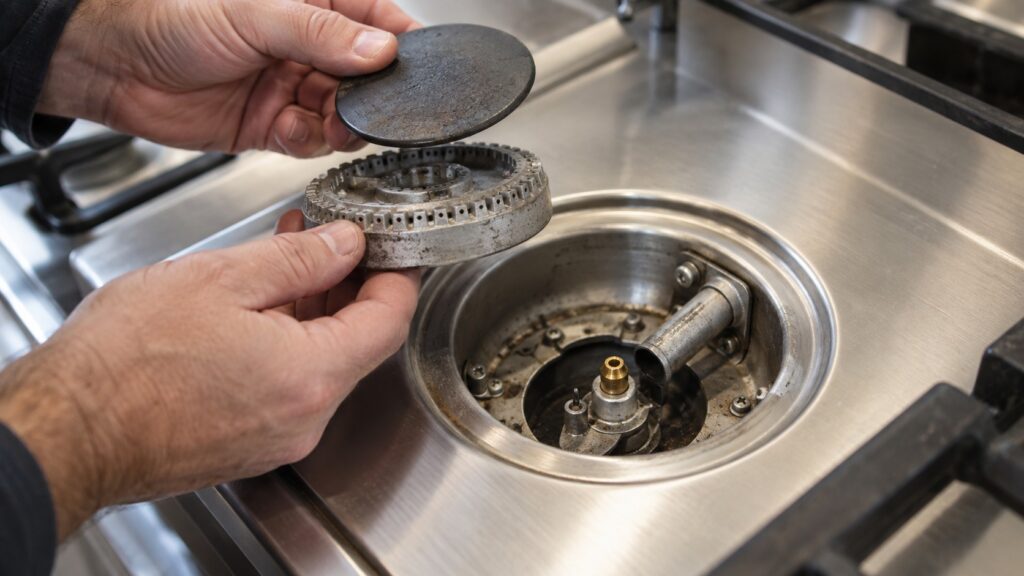
The burner head and its cap. They sit in a shallow pan that holds water, and they are the thinnest metal in the assembly. Corrosion works from the ports outward, and when enough ports are eaten the flame pattern goes ragged: tall flames on one side, nothing on the other, a ring that will not hold a simmer.
Next is the venturi and the orifice behind it. Insects nest in warm tubes that are left unused for weeks, and a partly blocked venturi produces a lazy yellow flame that soots the bottom of a pot. Our guide on a yellow flame on a DCS grill covers the same mechanism on the main burners and the same cleaning approach applies here.
When is a side burner worth repairing?
Whenever the housing and the valve are sound. A burner head, a cap, a grate and an electrode together cost a fraction of a replacement unit, and none of them requires opening a gas joint. Fitting a new head is a matter of lifting out the old one, seating the new one over the orifice, and confirming it sits square — with the gas off and the supply shut.
Repair also wins on a built-in unit even when several parts are involved, because a replacement is not just an appliance purchase. The cut-out has to match, the gas connection has to be remade under the counter, and the stainless finish of a new unit rarely matches ten-year-old neighbors in the same island. Three parts is still cheaper than a fitting job.
When does replacement make sense?
Four situations, and they are narrower than people expect. When the pan or housing has rusted through, because water then runs into the cabinet below and no part fixes a hole. When the valve leaks or will not turn and the parts are no longer available for that generation of unit. When a fuel conversion is wanted and no orifice kit exists for the burner in question. And when the island is being rebuilt anyway, at which point the marginal cost of a new drop-in is small.
Notice what is not on the list: a burner that will not light, a flame that has gone yellow, a grate that has pitted, an igniter that clicks. Those are the four complaints that bring most people to a side burner search, and all four are parts. The wider version of this arithmetic, across the whole grill, is in our DCS grill repair or replace guide.
What can you check before you decide?
- Lift the cap and look at the ports. Ragged, eaten edges mean a head; soot and blockage mean cleaning.
- Press on the pan. Soft spots and flaking from below mean water has been sitting in it for seasons.
- Turn the knob through its travel. It should move smoothly and return crisply. Gritty or loose is a valve conversation.
- Watch the flame with the lid open in daylight. A clean side burner runs blue with crisp cones all the way around.
- Check the lid habit. A side burner left uncovered fills with rain, and that single habit accounts for most of what fails on it.
Two safety limits. If you smell gas at the burner or under the counter, shut the supply and stop. And do not loosen the fitting between the valve and the manifold to test anything — that joint belongs to the person with a leak detector, not to an afternoon in the backyard.
What keeps a side burner from getting to this decision?
Close the lid after every use, and dry the pan before you close it so you are not sealing water in. Lift the cap and head off two or three times a season, brush the ports, and clear the venturi. Wash the stainless down with fresh water, particularly near the coast, using the same routine as the rest of the outdoor kitchen — our burner cleaning guide covers the brushing and the seating.
Run it occasionally, even when you are not cooking on it. A burner that fires once a month does not become a nest, and the flame burns off the moisture that does the corroding.
When to call a technician
Call when the valve is stiff, loose or leaking, when a smell of gas appears anywhere near the island, when the burner will not light after a clean head is fitted, or when a replacement unit has to be connected to the existing gas run. Gas connections and conversions are licensed work in most places and are not worth improvising over a burner.
We are an independent repair company, not a factory service arm. Pricing starts from a diagnostic visit and we confirm the estimate before any work begins. DCS grill repair covers side burners along with the main grill, and you can schedule a visit online or call 1-844-487-0065.