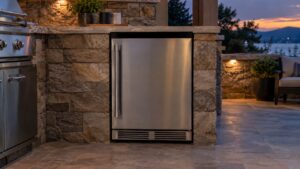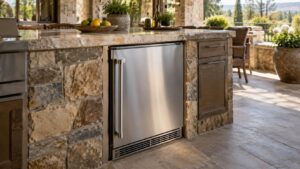
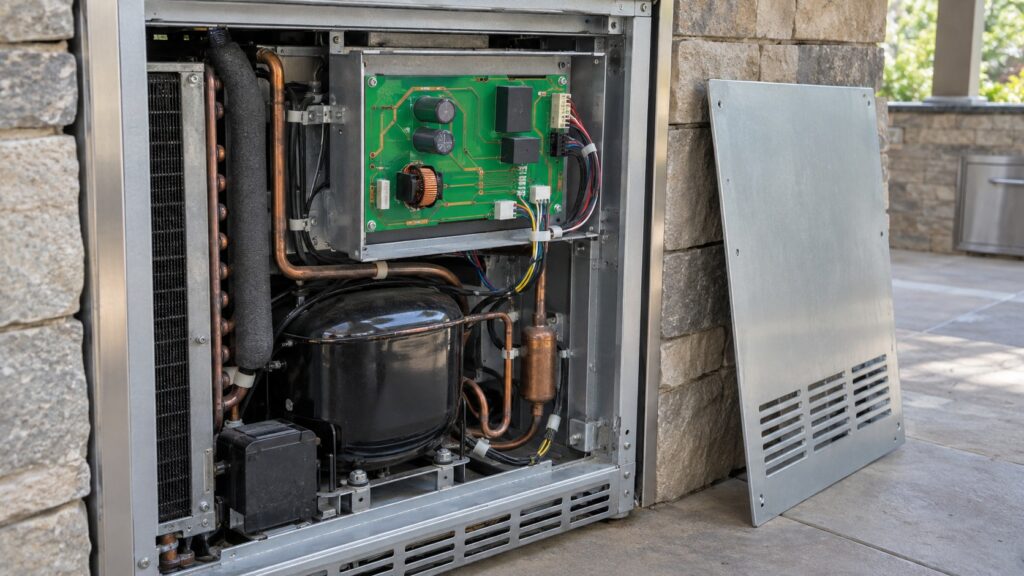
The DCS refrigerator control board is the part that turns temperature into decisions: it reads a pair of thermistors, compares them with the setting you chose, and switches the compressor, the evaporator fan, the damper and the defrost heater accordingly. Almost every code this appliance shows is produced somewhere along that chain, which is why understanding the chain explains more faults than memorizing the codes does.
What does the control board actually decide?
Four things, continuously. Whether the compressor should run, which it decides from cabinet and freezer temperature against the setpoint. Whether the evaporator fan should turn, which is not simply tied to the compressor — the fan stops when the door opens so cold air is not blown out at you. Whether the damper between the compartments should open, on units that divide one evaporator between two spaces. And whether it is time to defrost, which is a timer and a temperature working together rather than a fixed schedule.
The cooling hardware behind those decisions is covered in our explainer on how DCS outdoor refrigerators work. This guide is about the layer above it: the part that decides when that hardware runs.
How does a thermistor tell the board a temperature?
It does not send a number. A thermistor is a resistor whose resistance changes predictably with temperature, and the board applies a small voltage across it and measures what comes back. High resistance means cold, low resistance means warm, and the board converts the reading into degrees using a curve it was programmed with.
Two failure modes follow directly from that. An open circuit — a broken wire, a corroded pin, a cracked sensor — looks like infinite resistance, which is to say impossibly cold. A short looks like no resistance at all, which is to say impossibly hot. Both are outside any real temperature, so the board rejects them and raises a sensor fault such as the RL code rather than trying to cool to a number that cannot exist. Our NTC sensor glossary entry covers the component itself in more detail.
What is the CM code telling you?
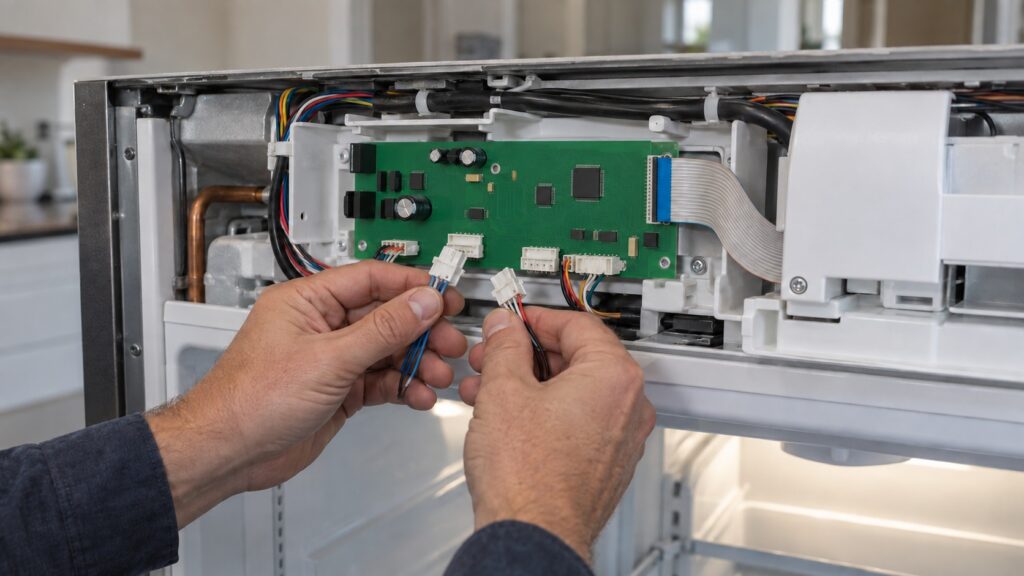
That the boards have stopped talking. In a modern appliance the panel you press is not wired to the compressor; it is a small board that sends messages to the main board over a few conductors. When those messages stop arriving, the main board raises CM, because it can no longer trust that what is on the display matches what it is doing.
Outdoors, CM has a strong environmental bias. A connector that sits in a cabinet exposed to humidity corrodes, a harness chafes where it passes a sheet metal edge as the unit is pushed in and out of its cut-out, and moisture wicks into a plug and bridges pins. The board itself is the last suspect, not the first. A CM that clears when the unit is unplugged for a minute and comes back a week later is describing a connection, and a CM that is there every time the door slams is describing a harness.
Why does the board make an outdoor unit behave differently?
Because the logic was written for an appliance that has to work in weather. Low ambient operation is the clearest example: when the air around a cabinet drops toward freezing, a naive control would simply stop calling for cooling, and the compartments would drift with the outside air. Outdoor-rated controls run the compressor anyway on a timed basis so the freezer section stays frozen in January.
Door logic is the other example. An outdoor unit gets opened far more often, for shorter periods, than a kitchen refrigerator, so the board is quicker to stop the fan and slower to panic about a temperature excursion. That tolerance is why a warm cabinet after a party is usually not a fault at all, a distinction our guide on weather against a real fault works through case by case.
Which faults are wiring, and which are the board?
A useful rule: the board is rarely the failed part, because it lives in the driest place in the appliance and has no moving parts. The things attached to it are what fail. Sensors sit in cold, damp air. Connectors sit in a cabinet that breathes with the weather. Relays on the board do wear, and a compressor that will not start while the board clearly wants it to is one of the few genuine board failures.
So when a code points at the control, the order of suspicion runs: connector, harness, sensor, then board. Reversing that order is how people end up with a new board and the same code, and the codes that most often lead there are CM, RL and FS — all three of which are reported in the full list in our DCS outdoor refrigerator fault code guide.
What can you do, and where should you stop?
- Power cycle once. Pull the plug or open the breaker for a full minute. A single reset is a legitimate test, not a fix.
- Read the display honestly. Note the exact letters and whether they return immediately or after hours.
- Compare with a thermometer. If the cabinet is at the right temperature and the board disagrees, you are looking at a sensor.
- Look for water. Any moisture in the cabinet below the unit belongs in the diagnosis.
Stop at the service panel. Behind it are line voltage connections, a compressor with a start capacitor that holds a charge, and on ice-making units a live water line. None of that is worth opening for a code you can describe accurately over the phone.
When to call a technician
Call when CM returns after a power cycle, when a sensor code persists, when the compressor never starts or never stops, or when temperature codes such as CH, CL, FH and FL keep coming back after the condenser is clean and the seal is good. All of those are meter work.
We are an independent repair company, not a factory service arm. Pricing starts from a diagnostic visit and we confirm the estimate before any work begins. DCS outdoor refrigerator repair covers sensors, harnesses and control boards, and you can schedule a visit online or call 1-844-487-0065.