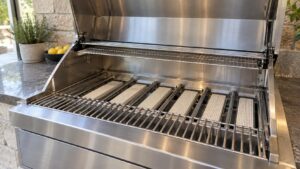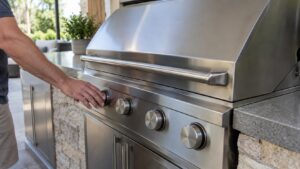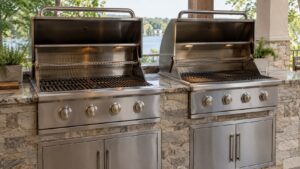
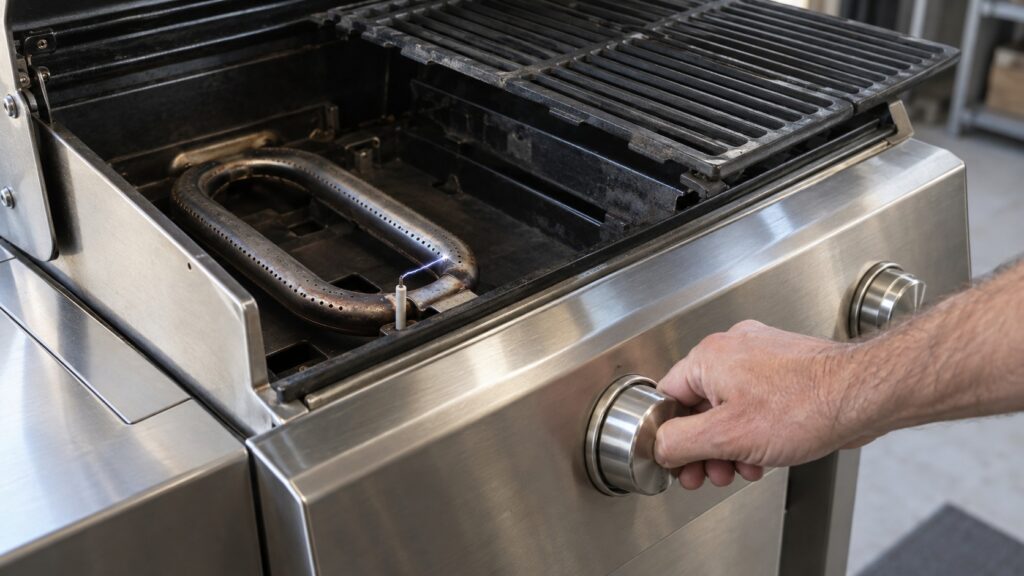
A DCS grill igniter that clicks without lighting, or lights one burner and not the next, is almost never a dead spark module. The spark system is four things in series — a power source, the module, the electrode, and a ground path back to the burner — and on a grill that lives outdoors it is the last two that fail. The fastest way to sort this out is in daylight with the hood open: watch where the spark goes, not whether you hear clicking.
How does the DCS grill igniter actually light a burner?
The module builds a high voltage pulse and sends it down an insulated wire to an electrode mounted a fraction of an inch from a burner port. The spark has to cross an air gap to a grounded metal surface, and the burner itself is that ground. Gas flows out of the port, the spark crosses the gap through the gas stream, and the flame carries along the burner and across to its neighbors through the crossover tube.
Every failure in this system is a failure of one of those conditions: no pulse, no path down the wire, no gap, no ground, or no gas in the gap at the moment the spark happens. That framing is worth holding onto, because it turns a vague complaint into five things you can check in order.
Why does the igniter click but never spark?
Clicking is the module doing its job. If you hear it and see nothing at the burner, the pulse is dying before the gap. Three causes cover most of it outdoors.
Moisture is first. Rain, hose spray from washing the island down, or a morning of heavy dew leaves a film across the ceramic insulator, and the pulse tracks along that film to ground instead of jumping the gap. A grill that starts fine at noon and clicks uselessly at eight in the morning has a moisture problem, not an electrical one. Second is carbon: grease that has baked onto the ceramic is conductive and does the same thing permanently. Third is a cracked insulator, which is what happens when a grate is dropped on an electrode or the burner is refitted carelessly.
What is the right gap, and why does it matter so much?
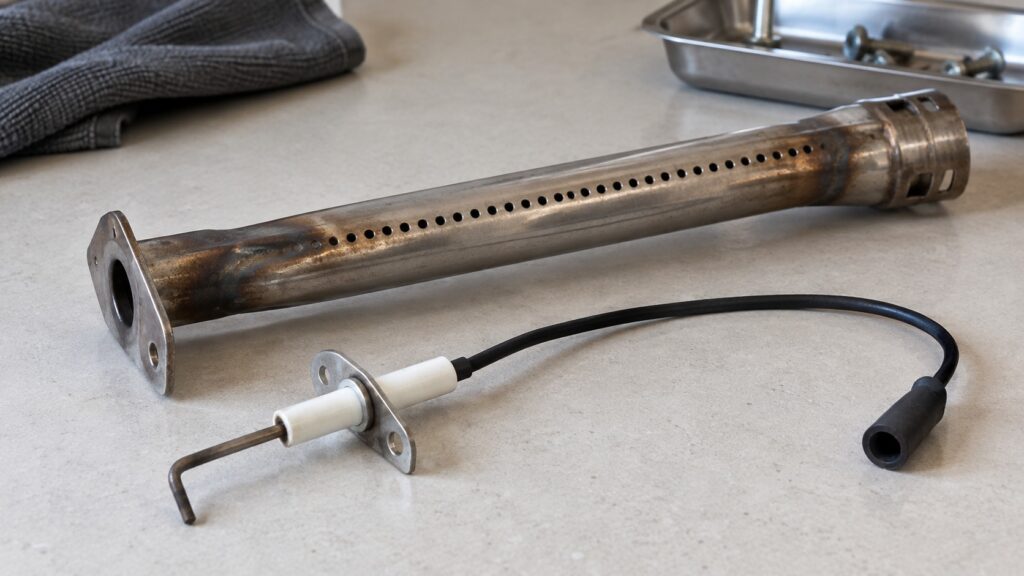
The electrode tip should sit close to the burner port — near enough for the spark to cross easily, far enough that it does not touch. When the gap is too wide, the pulse looks for an easier route and jumps to whatever grounded metal is nearest, often a screw or the burner casting an inch away, where there is no gas. When the gap is too tight, the electrode shorts to the burner and you get the click with no visible spark at all.
Gaps move on their own. Outdoor burners expand and contract through hundreds of cycles, mounting brackets loosen, and an electrode that was set correctly at the factory drifts over a few seasons. A bent tip is usually straightened rather than replaced, gently, with the gas off and the burner cool.
Sparks but no flame: is this the igniter at all?
No. If you can see a healthy blue-white spark crossing the gap and nothing lights, the ignition system has done everything it can and the problem is gas delivery. Start at the supply: an empty cylinder, a shutoff left closed, or a regulator in its reduced flow state after the cylinder valve was opened too quickly with a grill valve open. Reset that by closing everything, waiting a minute, then opening the cylinder valve slowly with all grill knobs off.
Then look at the burner. A burner tube that is not seated over its orifice sprays gas into the cabinet rather than through the ports, and a spider nest in the venturi blocks the flow entirely — the classic spring failure on an outdoor grill. Our guide on cleaning DCS grill burners covers seating and clearing them, and the symptom page for a burner that will not ignite works through the same sequence from the other direction.
What keeps the ignition system alive outdoors?
- Cover the grill. Nothing extends igniter life like keeping rain out of the control panel and off the electrodes.
- Dry it before you judge it. After a storm, run the grill on a working burner for ten minutes and try again.
- Change the battery before each season where the module is battery powered, and clean the contacts with a brush.
- Wipe the ceramic. A dry cloth on the insulator during your burner cleaning takes ten seconds.
- Burn off after cooking. Grease that never bakes onto the electrode never has to be scrubbed off it.
One safety line that is not negotiable: if you smell gas, stop. Do not keep pressing an ignition button in a grill cabinet that has been filling with propane, and do not lean over an open hood while you do it. Turn everything off, shut the supply, and let the cabinet air out completely before trying again.
Replace the electrode, or the whole assembly?
Electrodes are cheap and they are the part that fails, so a single cracked insulator is a single part. When two or three have gone at once, the grill is telling you about its environment rather than about the electrodes, and the wiring is usually as tired as they are. The module is worth suspecting only when no burner sparks, the battery is fresh, and the contacts are clean.
Ignition parts sit inside the grill head rather than in the cart or island, which is why they travel with the grill when a head is replaced — our grill head glossary explains where that line falls, and repair against replace covers when a grill with several tired systems stops being worth parts.
When to call a technician
Call when you smell gas at any point, when one burner will not light while its neighbors do after cleaning, when the igniter fires continuously with all knobs off, or when a valve feels stiff or will not return. Valves and manifolds are not backyard work, and an ignition fault that keeps coming back usually has a wiring or grounding cause that takes a meter to find.
We are an independent repair company, not a factory service arm. Pricing starts from a diagnostic visit and we confirm the estimate before any work begins. DCS grill repair covers electrodes, modules, valves and burners, and you can schedule a visit online or call 1-844-487-0065.