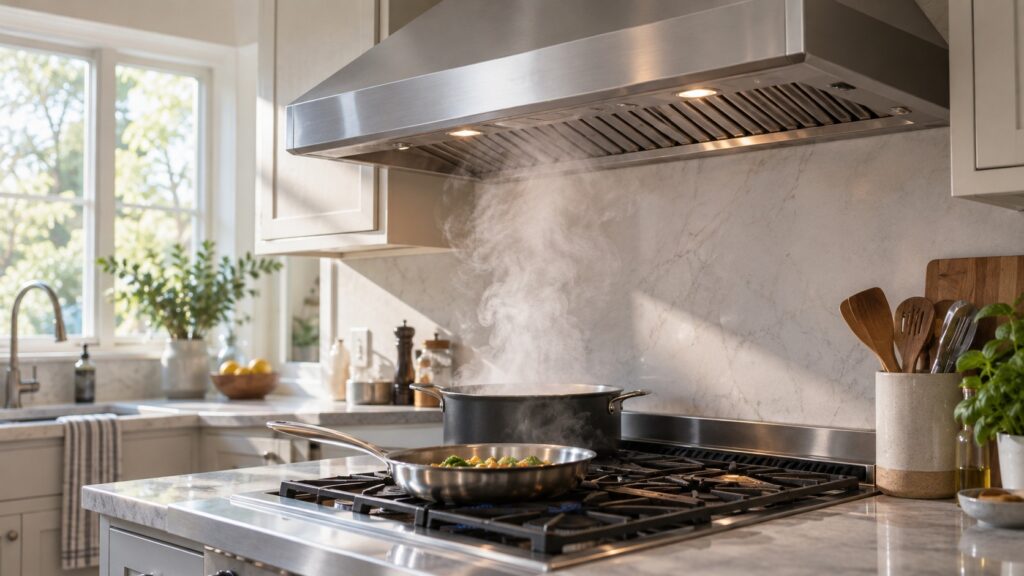
A DCS range hood is the appliance most often blamed for a problem caused by how it is used. Switched on late, run on the wrong speed and switched off the moment cooking stops, even a well-sized hood over a good duct will leave grease on the cabinets and smoke in the room. None of what follows costs anything, and together it is worth more than several hundred extra CFM.
Switch it on early, not when you notice
A hood captures a plume while the plume is still a coherent column rising from the pan. Once it has spread across the ceiling and around the room, the hood is trying to filter an entire kitchen through an opening a few feet wide, which it cannot do at any speed.
Turning the hood on a minute before the pan heats costs nothing and changes the result completely, because the airflow is established before there is anything to capture. This single habit is the difference most people notice immediately.
Use the lowest speed that works
High speed is loud, and noise is why hoods get switched off. It also removes more conditioned air from the house than any other setting, which costs real money in a cold or a hot month. Most cooking — simmering, a covered pot, gentle frying — is handled at the lowest or second speed, and the hood is then quiet enough to leave running.
Save high for searing, wok cooking and anything that has started to smoke. Used that way, a hood is a background appliance rather than an intrusion, and it is actually on when it matters.
Leave it running afterwards
When the pan comes off the heat, the room is still full of what it produced and the duct still holds warm greasy air. Switching off immediately leaves that to settle onto the cabinets and the ceiling. Ten to fifteen minutes of continued running clears both.
If the hood has a timer or a delay-off, use it — that is exactly the feature’s purpose, and it removes the need to remember. If it does not, the habit is worth building anyway.
Cook where the hood can reach
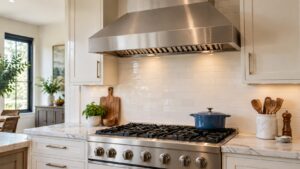
- Rear burners for anything that smokes. The capture area is above and behind; a front burner is the furthest point from it.
- Lids are free ventilation. A lid on a simmering pot removes most of what the hood would have to deal with.
- Tall pots are the hard case. A stock pot puts its plume high and wide. Use a rear burner and a lid.
- Do not let a pan hang off the front edge. It moves the plume forward, out of the capture zone.
Filters, and the airflow you cannot see leaving
Grease accumulates on baffles and mesh gradually, and airflow falls with it just as gradually. Nobody notices a hood getting weaker by two percent a week, and after a year the same appliance on the same speed moves a fraction of what it did. Then it gets replaced.
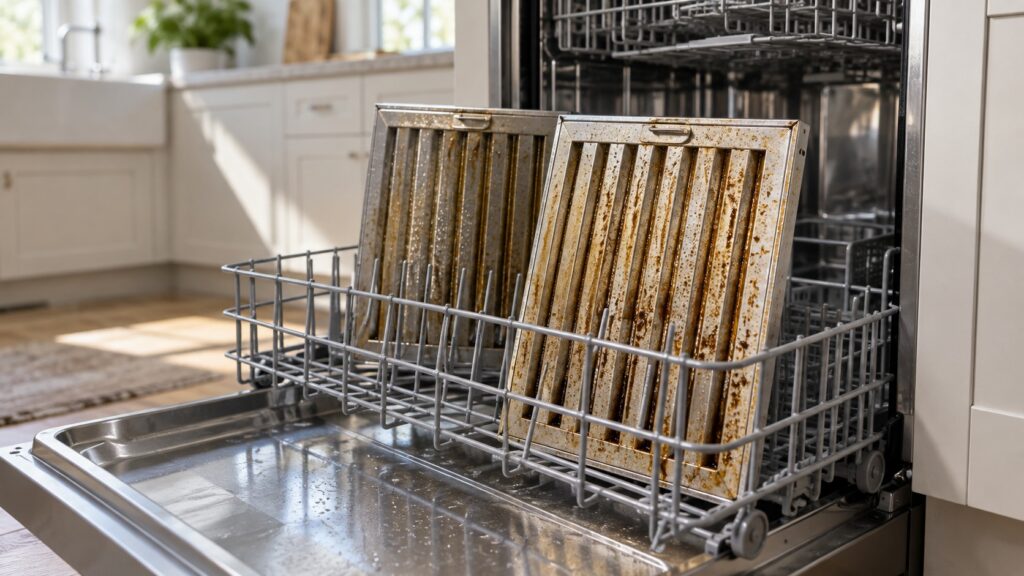
Filters go in the dishwasher, and the interval depends entirely on what you cook: a household that sears and wok-cooks needs them monthly, one that mostly boils and bakes can go several months. Our filter cleaning guide covers the routine, and the deep clean guide covers the surfaces behind them.
Make-up air, and the door that pulls shut
If a door pulls itself closed when the hood runs on high, or a fireplace smokes back into the room, the house is being depressurized: the hood is removing more air than the building can replace. That is a make-up air question and it is a safety matter rather than a comfort one, because a combustion appliance elsewhere in the house can backdraft.
In the short term, cracking a window while the hood runs high relieves it. In the longer term it is worth addressing properly. Our guide on downdraft installation covers the same requirement from the other direction.
Outdoor hoods, and the habits that differ
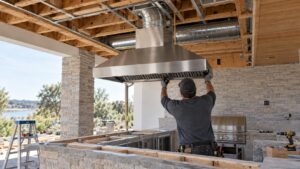
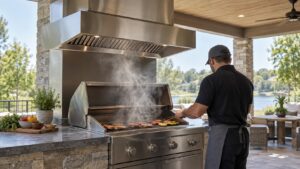
A hood over a grill has a harder environment and an easier duty cycle. Wind matters: a hood fighting a breeze across an open patio captures far less, and there is no fixing that except siting. Cover the grill rather than the hood, wash the stainless down with fresh water regularly, and expect the filters to collect far more in a single grilling session than an indoor hood does in a week.
Our guide on weather against real faults covers what to expect from outdoor ventilation generally.
Lighting, and using the hood as task light
Hood lights are the most-used light in most kitchens, and they are worth thinking about as a tool rather than as a feature. Cooking under the hood’s own light, rather than under general room light, means you are looking at the pan with the shadows falling away from you instead of across it — which matters more than people expect when judging color on a sear.
Two habits help. Use the brightest setting while cooking and the lowest afterward, so the lamps are not running at full output for hours. And clean the lenses when you clean the filters: a film of grease on a lens costs a surprising amount of light and builds so slowly that nobody attributes the dimness to it.
When habits are not the problem
A hood that has become noisy, one stuck on a single speed, one that will not switch off, or capture that fell off suddenly rather than gradually — those are the appliance. So is poor capture with clean filters and a cap that visibly opens outside.
We are an independent repair company, not a factory service arm. Pricing starts from a diagnostic visit and we confirm the estimate before any work begins. DCS range hood repair covers blowers, controls and dampers, and you can schedule a visit online. Before spending anything, our repair or replace guide lists what to rule out first.