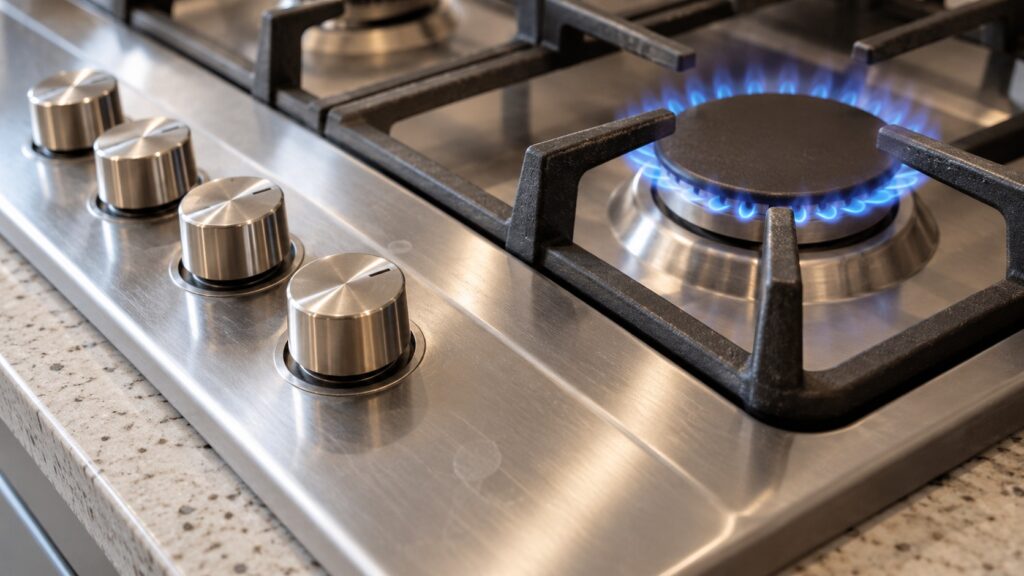
The DCS cooktop burner valve flame chain starts at the knob: the valve is the part that turns a knob movement into a flame. When you turn a knob, you move a gas valve: it lets gas flow to that burner, and the amount of gas it lets through sets the size of the flame. The gas then mixes with air, a spark lights it and a ring of blue flame appears. Our pages note that DCS gas cooktops are mechanical, with no error codes, so you diagnose by the flame itself. Understanding the valve explains why a stiff knob, a flame that will not go low and a burner that clicks without lighting are different problems with different fixes, and why none of them is a job for an owner with a screwdriver.
What does the burner valve actually do?
It is a metering valve. Gas comes from the supply to each burner’s valve, and the knob rotates a part inside the valve that opens or closes the path. At the highest setting the path is wide, so the burner gets the most gas; at a low setting it is narrow, and the flame shrinks to a simmer. The valve does not light the burner and does not mix the air; it just decides how much fuel goes forward. The exact way the valve is built, including how the low setting is held, differs by model, so we do not describe the internal mechanism. What matters to an owner is what the valve controls and what its failure looks like.
How do the knob, valve, burner and igniter work together?
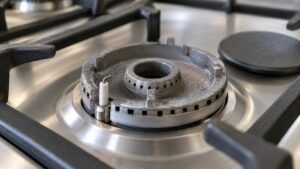
Turning the knob opens the valve and, depending on the model, also triggers the spark; your owner’s manual describes the sequence for your cooktop. Gas leaves the valve through a small opening, an orifice, which meters it into the burner. In the burner it mixes with air and exits through the ports in the cap, forming a ring of flame. Our guide on how DCS sealed burners work explains that gas mixes with air at the burner, a spark igniter lights it and the cap shapes the flame for even heat under the cookware. Each link can fail independently.
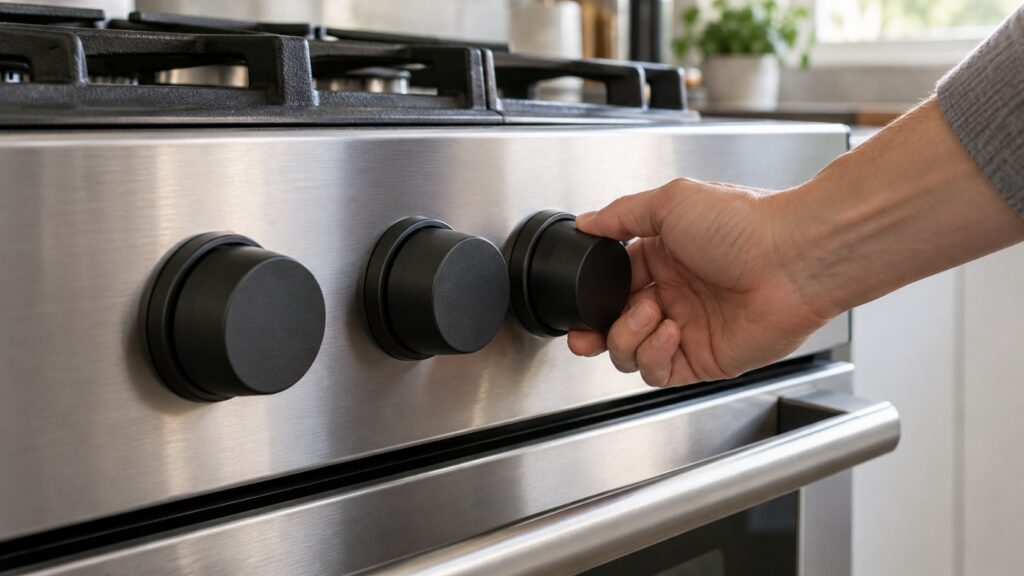
How does the valve make a simmer possible?
A simmer is a very small, stable flame, and it takes a valve that can hold a narrow flow and a burner that can keep a flame alight at that flow. DCS describes its dual-flow burner as designed to work cleanly across a wide heat range, from a powerful high flame for boiling down to a stable low simmer; see our dual flow burner glossary. If a burner will not simmer or the flame goes out at low, the valve, the orifice or the burner may be at fault, and our won’t simmer page covers the symptom. Do not try to adjust a simmer setting yourself.
What does a valve problem look like?
A knob that is stiff, gritty or hard to turn can mean a worn or contaminated valve; see the stiff knob page. A flame that lifts off the burner, is too high or will not reduce can point to a valve or a gas supply problem; see flame lifts off. A burner that clicks but will not light may have a blocked port or an igniter that does not reach; the burner won’t ignite page covers it. A weak flame is more often a clogged port or a tilted cap than a valve, as our weak flame troubleshooting guide explains: clean the ports and reseat the cap first.
What can you do yourself?
Keep the cooktop clean. With the burner off and cool, lift the cap, clear the ports with a straightened paperclip and brush the cap, as our cooktop cleaning guide describes. Seat the cap squarely, since a tilted cap distorts the flame. Wipe spills before they bake onto the burner. Do not spray cleaner into the knob openings, do not pull off a knob and spray lubricant into the valve, and do not take the panel off to look at the valve. If a knob is stiff, do not force it, because a forced valve can fail or leak. Gas parts are a technician’s job, and so is any change of orifice for a different fuel.
What if you smell gas?
If you smell gas at any time, do not turn on or off any switch or appliance, do not light anything, put out any open flame, leave the house and call your gas company or 911 from outside. Do not try to find the leak with a flame or soap bubbles, and do not go back in until you are told it is safe. Make sure all knobs are off after cooking. See our gas smell safety steps.
When should you call a technician?
Call if a knob is stiff or does not move smoothly, if a flame lifts, sputters or will not reduce, if a burner will not light after cleaning, or if there is any gas smell. Our DCS cooktop repair page explains how a visit works, and the cooktop repair vs replace guide helps if you wonder whether the cooktop is worth fixing.