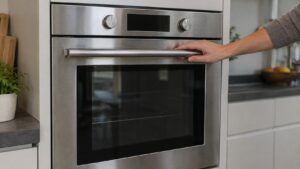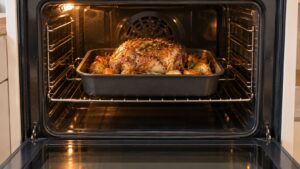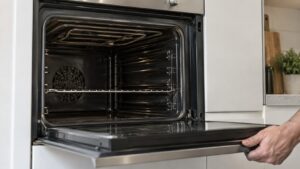
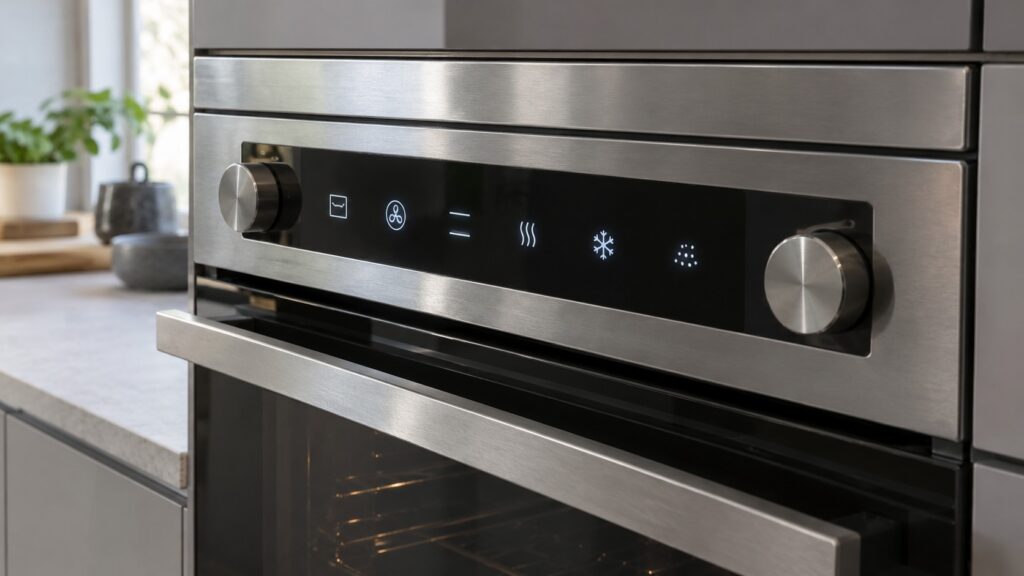
The DCS bake and broil settings meaning comes down to where the heat comes from. Bake is the everyday cooking mode, which heats the oven cavity so food cooks evenly in still air. Broil is high, direct heat from above, for browning and finishing. Convection adds a fan to move the heated air. Around those three sit a handful of other terms you will meet on a DCS oven: preheat, self-clean, timer, delay start and lockout. This glossary explains them in general terms. What a given setting does on your exact model is in your owner’s manual, and the labels differ between wall ovens and ranges.
What does bake mean on a DCS oven?
Bake is the setting you use most. The oven heats the cavity to the temperature you choose and then cycles its heat source on and off to hold it. On a gas oven that heat comes from a burner under the oven floor, lit by an igniter; on an electric or dual-fuel oven it comes from an element. Our page on DCS oven not heating notes that the bake igniter on a gas oven glows first and then opens the gas valve, and that DCS wall ovens are mechanical with no numeric error codes, so problems show up as symptoms. Bake gives rise and fall of temperature around the setpoint, which is normal as the heat cycles.
What does broil mean, and how is it different from bake?
Broil uses heat from above instead of heat that fills the whole cavity. It is intense and direct, so it browns, melts and chars the surface of food quickly. Food goes on an upper rack, a pan holds it, and you watch it. The position of the door during broiling and the temperature settings differ by model, so follow your manual. On a gas oven there is a broil burner; on an electric oven there is an element; which one your oven has depends on the model. Our how a DCS oven broiler works guide goes through the mechanism, and the weak broil page covers what to look for when it underperforms.
What does convection mean?
Convection adds a fan that circulates the hot air so that every rack sees a similar temperature. Our guide on how DCS convection ovens work describes true or European convection, where a dedicated element heats the circulating air, convection bake, where the fan moves heat from the standard elements, and convection roast, which uses more airflow for browning meat and crisping skin. It also notes that most recipes call for a lower temperature and an earlier check when you use convection. The exact modes on your oven depend on the model, so check your manual before assuming one is available.
What do preheat, timer and delay start mean?
Preheat is the period when the oven heats up to the setpoint before you put food in; most ovens signal when they reach it, and the way yours does so depends on the model. A timer counts down and may or may not shut the oven off, so read your manual before you rely on it. Delay start is a feature that starts cooking later, if your model has one. If an oven will not heat, our troubleshooting page suggests checking that no timer or delay-start mode is active, because those can look like a failure. We do not give times or temperatures here, since they depend on your model and recipe.
What do self-clean and lockout mean?
Self-clean is a high-heat cycle that reduces baked-on residue to ash you wipe away. The door locks during the cycle and stays locked until the oven cools, which is normal; never force it. Our self-clean guide covers preparation and what to do afterward. A lockout is a control lock that stops settings being changed or the oven being started by accident; how to engage and release it depends on your model. If an oven seems to ignore your settings, a lockout or a delay mode is worth checking before you suspect a fault, and the manual is the place to look.
Which oven terms are related but different?
Calibration is the adjustment that brings the oven’s real temperature in line with its dial or display, and our oven calibration guide explains how to test it with a thermometer. Rack position determines how close food is to the heat; see the rack care tips. A range combines an oven with burners, while a wall oven is built into cabinetry; our single vs double wall oven guide covers that choice. If you are not sure which oven you own, the model number on the rating plate is the key to the right manual.
How should you use these terms when talking to a technician?
Describing a problem with the right words saves time on a service visit. Say which function does not work: “bake does not heat”, “broil is weak”, “the convection fan is noisy”, “the door stays locked after self-clean”. Say what you see and hear, such as an igniter that glows without lighting or a burner that clicks, and say what changed just before, for example a power cut, a spill or a self-clean cycle. Our oven pages note that DCS wall ovens use analog thermostatic control and most models show no numeric codes, so a clear description of the symptom is the diagnostic information the technician starts with. Have the model number from the rating plate ready.