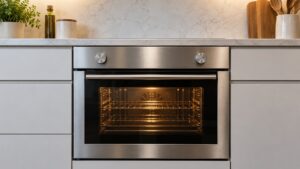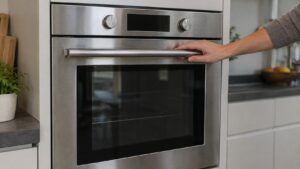
DCS oven door glass cleaning is a cold, gentle job. Wait until the oven is completely cool, wipe the outer glass with a non-abrasive cleaner and a soft cloth, follow your owner’s manual for the inner glass, and keep liquid away from the gasket and the vents at the edges. Our own self-clean guide says the same thing in one line: clean the door glass and frame separately with a non-abrasive cleaner. There is no need to take the door off for ordinary cleaning, and nothing about it needs special tools.
Why does an oven door glass get so dirty?
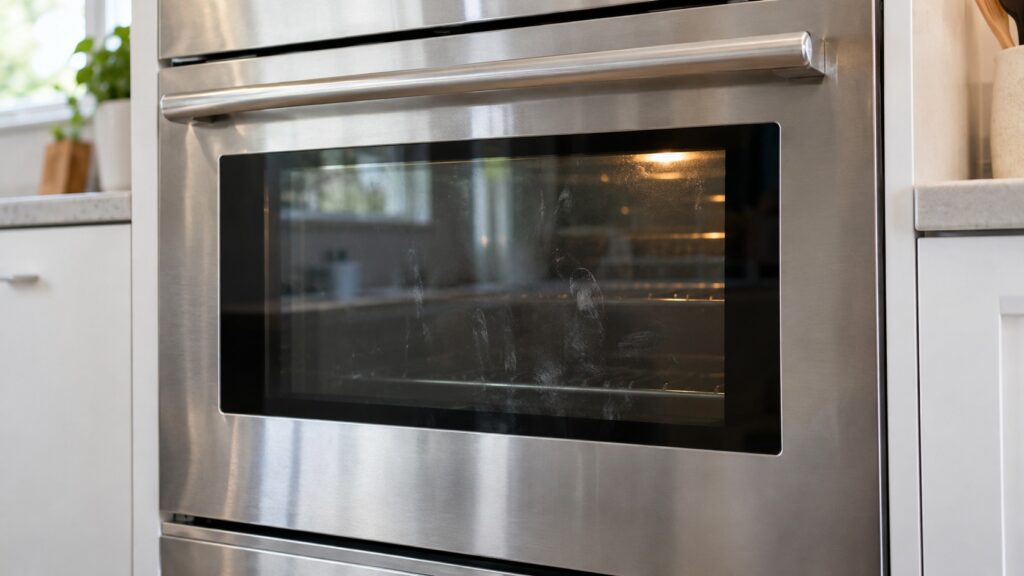
Cooking splatter, grease vapor and smoke condense on the cooler glass and bake on every time the oven heats. The outer face collects fingerprints and cleaner residue, and the inner face is coated by splatters and film. The inner face is the harder one, since it sits behind the outer pane. Our self-clean guide notes that the self-clean cycle turns residue in the cavity to ash but that the door glass and frame should still be cleaned separately, so even a self-clean does not finish the glass.
How do you clean the outside of the glass?
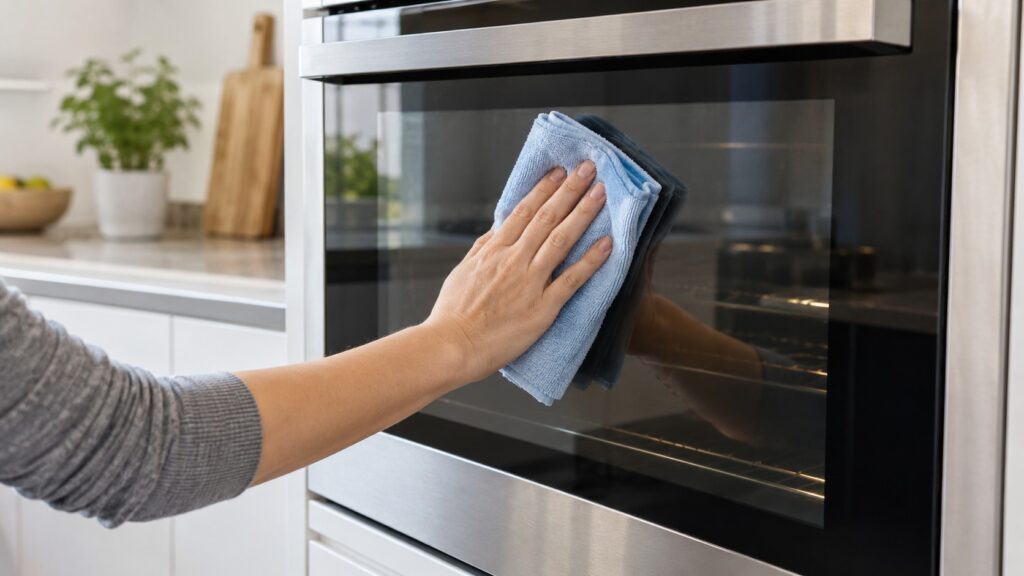
Start with the simplest method. With the oven cool, wipe the glass with a soft cloth dampened with warm water and a few drops of dish soap, then wipe with a clean damp cloth and dry with a microfiber cloth to avoid streaks. For stubborn fingerprints or grease, use a non-abrasive glass or oven-glass cleaner according to its label, sprayed on the cloth rather than directly on the door, so liquid does not run into the seams. Work with the door closed or at the angle your manual suggests, and wipe in straight lines. Never use steel wool, a razor scraper or a scouring powder, which can scratch the glass and create weak points.
What about the inside glass?
The inner glass is where the baked-on film lives, and the way to reach it depends on the door construction of your model. Some doors can be cleaned from the front with a cloth through the cavity opening, and some owners are tempted to take the door off or take the glass apart. We do not recommend that: the door is heavy, the glass edges are sharp and the assembly is built to go together in one way. Follow your owner’s manual for the inner glass. If the manual shows no owner access and a film remains between or behind the panes, it is a job for a technician. We do not give hinge or door-removal steps, because they are model-specific.
How do you protect the gasket and the vents?
The gasket seals the door to the oven, and the vent slots let air move through the door. Soaking either with cleaner shortens its life or fills it with residue. Keep the cleaner on the cloth, wipe the frame and the glass, and use a dry cloth near the edges. Do not rub the gasket hard, and do not use solvents on it. Look at it while you clean: tears, flat spots or sections that have pulled away mean the seal is losing heat, and our oven door seal troubleshooting guide and the oven door won’t seal page explain what to do about it.
How can you keep the glass cleaner for longer?
Wipe up spills as soon as the oven has cooled, use a pan with sides high enough to catch splatter when you roast, and use a splatter guard for fatty cuts. Do not line the oven with foil to catch drips, since foil can trap heat and damage the finish, as our self-clean page cautions. Wipe the glass lightly and regularly instead of waiting for a heavy film, and use the self-clean cycle only when the cavity needs it. A light, frequent wipe is gentler on the glass than a hard scrub once or twice a year.
What about the door frame and the handle?
The stainless frame around the glass collects grease and fingerprints too. Wipe it with the grain using a soft cloth and a little mild soap in warm water, rinse by wiping with a damp cloth and dry it. Do not use abrasive pads on the finish, which scratch it and make it show every mark. Our 304 stainless glossary covers the finish in more detail. Clean the handle at the same time, and check that its mounting is firm, because a loose handle is easy to overlook and puts strain on the door when it is used to pull the door open.
Take your time and work in daylight so you can see streaks, and finish by opening and closing the door slowly to check that nothing rubs. A door that has been cleaned should move as it always did. If it sticks, drags or does not close flush, stop and do not force it.
When is it more than dirt?
If the glass is cracked, chipped or shows a crack line, stop using the oven and call a technician, because heat can make a damaged pane worse. If the film does not come off with the methods above, or if you see moisture or smoke between the panes, the cause is not something you can wipe away. A door that no longer closes flush also needs a look. Our DCS oven repair page explains how a visit works. For the broader oven picture, our range deep clean guide is a good companion.