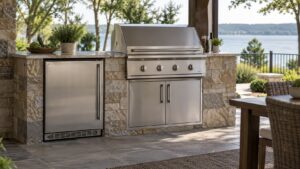
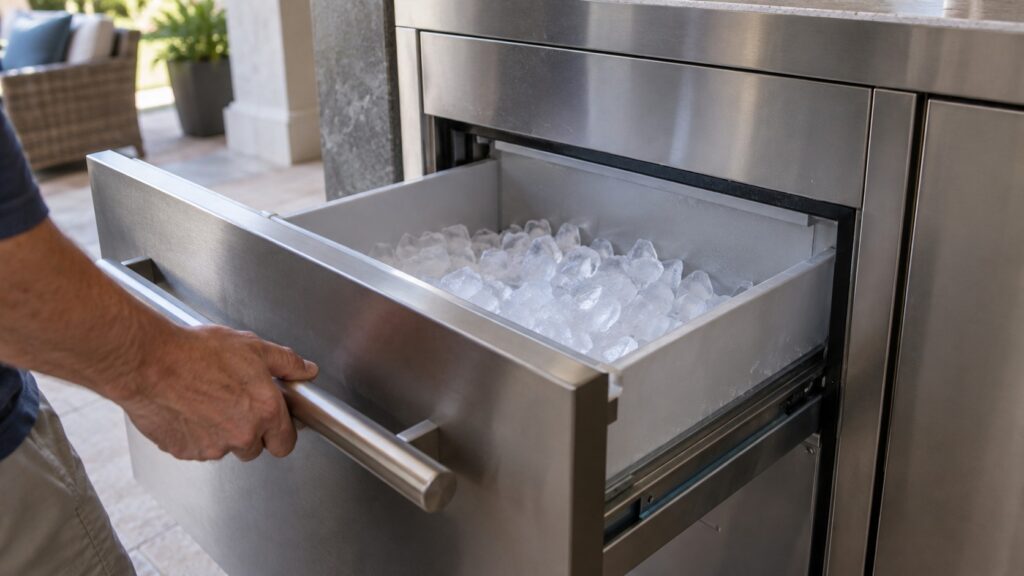
The DCS ice maker codes are three letters that divide one complaint — no ice, or not enough of it — into three very different repairs. IM flags a problem with the ice maker module itself, IF means the control has been told the bin is full or that a fill and harvest cycle did not complete, and IW points at the ice and water supply: the inlet valve, the line or the pressure behind it. Read the letter before you touch anything, because the fix for one of them is a shutoff valve and the fix for another is a module.
What does IW mean, and why is it the one to check first?
IW is a supply complaint. The control asked for water, the fill did not happen the way it expected, and it said so. Outdoors this is the most common of the three by a wide margin, and the reasons are mostly plumbing rather than appliance.
Work upstream in order. The shutoff valve under the counter or in the wall, which people close for winter and forget to reopen. The saddle or compression fitting, which weeps and clogs. The line itself, which on an outdoor run can be crushed where it passes a stud or pinched behind the cabinet when the unit was pushed back into its cut-out. Then pressure: a low-pressure supply that is fine for a hose bib can be marginal for a fill valve that needs to deliver a measured shot in a few seconds.
The valve is last on the list, not first. A fill valve that has failed electrically is a real fault and an ordinary part, but replacing one because the shutoff was closed is a repair nobody needed.
What does IF mean when the bin is obviously not full?
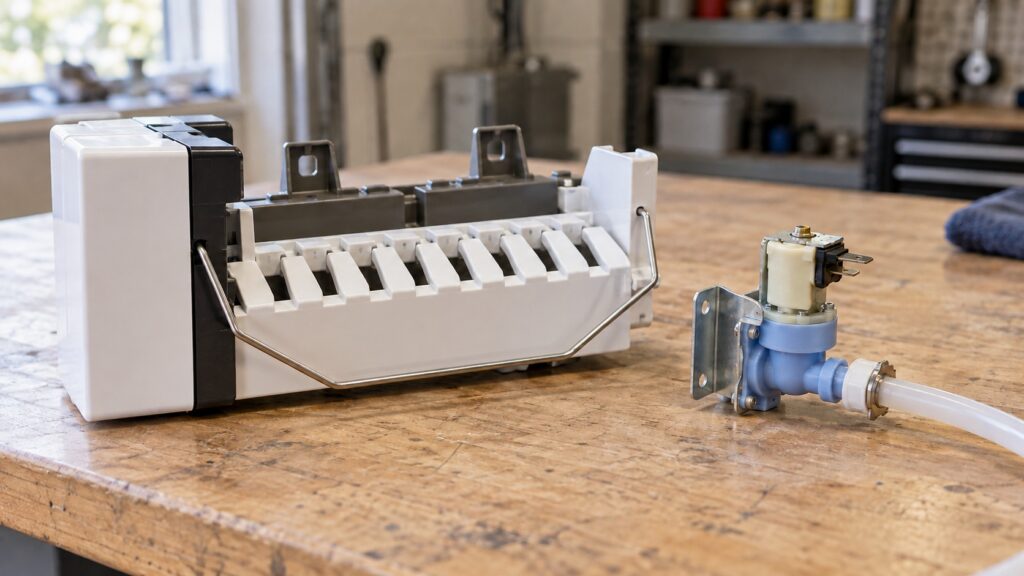
IF is the code that confuses people most, because it appears on an empty bin. The control does not see ice; it sees a signal that stands for ice. On a mechanical module that is the bail arm — the wire that rides on top of the cubes and shuts production off when it cannot drop. If the arm is held up by a bag of ice someone stuffed in, by a bottle, or by a cube that fused to it, the unit reads the bin as full and stops. Free it and the code clears.
The second cause of IF is a harvest that did not finish. The mold fills, the cubes freeze, the harvest arm sweeps, and one cube welds itself into a corner. The sweep stalls, the cycle never reports complete, and the control raises IF. The cure is a manual thaw rather than a screwdriver, and our outdoor ice maker maintenance guide covers the thaw and the cleaning schedule that prevents the welding in the first place.
What does IM mean, and when is it really the module?
IM is the code that names the ice maker itself. Inside the module there is a small motor, a gear train, a thermostat or thermistor that decides when the cubes are frozen, and a mold heater that lets the harvest arm break them loose. A failure in any of them shows as IM.
Before accepting that, rule out the two things that mimic it. A freezer section that is not cold enough will never satisfy the harvest thermostat, so the cycle stalls and the module gets blamed for a cooling fault — which is why an IM that arrives alongside the FH warm-freezer code should be treated as a temperature problem first. And an ice maker that was switched off at its own toggle reports as a module that is not producing.
Why does an outdoor ice maker fail more often than an indoor one?
Three reasons, all of them environmental. Ambient heat: an ice maker in a 100 degree island has to remove far more heat per cube than one in a kitchen, so cycles lengthen and production drops long before any code appears. Freezing: an outdoor supply line that runs through an unheated wall or an open island will freeze solid in a cold snap, and a frozen line reads exactly like a closed shutoff. And water quality: outdoor units are often fed from a line with no filter, so the valve screen silts up and the fill slows a little each season.
That is also why winterizing matters more here than for anything else in the cabinet. Our guide on winterizing a DCS outdoor refrigerator covers draining the ice maker line, which is the step that prevents both a split fitting and a spring full of IW codes.
What can you check safely yourself?
- The toggle or arm. Confirm the ice maker is switched on and that nothing is holding the bail arm up.
- The bin. Empty it, break up any fused block, and wipe it dry.
- The shutoff. Find the supply valve and confirm it is fully open, not cracked open.
- Production over time. Give a healthy unit 24 hours from a cold start before judging output.
- Freezer temperature. Put a thermometer in the freezer section. Ice production is the first thing to suffer when it drifts.
Stop at the water line. Do not loosen a compression fitting to see whether water arrives, and do not pull a valve with the supply live. A line that lets go inside a built-in island floods a cabinet you cannot easily reach, and a wet control board turns an ice complaint into a much larger repair.
When to call a technician
Call when IW survives an open shutoff and a thawed line; when IF returns after the bin is cleared and the arm moves freely; when IM persists with the freezer section holding temperature; or when you find water anywhere in the cabinet below the unit. Those are valve, module, harness and control faults, and all four are ordinary parts work for someone with the meter and the fittings.
The complete list of what this control reports is in our DCS outdoor refrigerator fault code guide. We are an independent repair company, not a factory service arm. Pricing starts from a diagnostic visit and we confirm the estimate before any work begins. DCS outdoor refrigerator repair covers ice makers, fill valves and the controls behind them, and you can schedule a visit online or call 1-844-487-0065.