The DCS outdoor ice maker repair or replace decision is usually a repair decision. Ice makers that slow down, make cloudy or small ice or stop making ice most often suffer from mineral scale, a water-flow restriction, a worn door seal or a part such as a water valve or fan, and all of those are repairable. Replacement becomes reasonable when a sealed-system failure hits an older unit, when the built-in no longer suits the outdoor kitchen or when faults keep coming back. This guide explains what to try, what a technician looks at and how the built-in cutout changes the math.
What usually goes wrong with an outdoor ice maker?
An outdoor ice maker works against heat and often runs on hard water, which scales every surface it touches. Our outdoor ice maker maintenance guide says slow or cloudy ice usually means scale or a water-flow restriction, and that if cleaning and descaling do not restore it, the water valve or the cooling system may need service. Door seals, fans and ice-maker modules also take the brunt of heat, humidity and sun. Our outdoor beverage ice maker troubleshooting guide and the no ice and small ice pages cover the symptoms.
What should you try before calling anyone?
Do the owner-level maintenance. Empty and sanitize the bin, then clean it with mild soapy water and rinse, as the maintenance guide describes. Descale on the schedule in your model’s instructions, with the approved solution only. Check that the water supply line is clear, free of kinks and leak-free, and replace the water filter on schedule if your model has one. Check that the door closes fully and that the front vent is not blocked. Make sure the unit has not been shut off at the breaker by a tripped GFCI. These steps cost very little and cure many ice-production complaints. Do not open panels or disconnect water fittings beyond what the manual describes.
When is repair the right call?
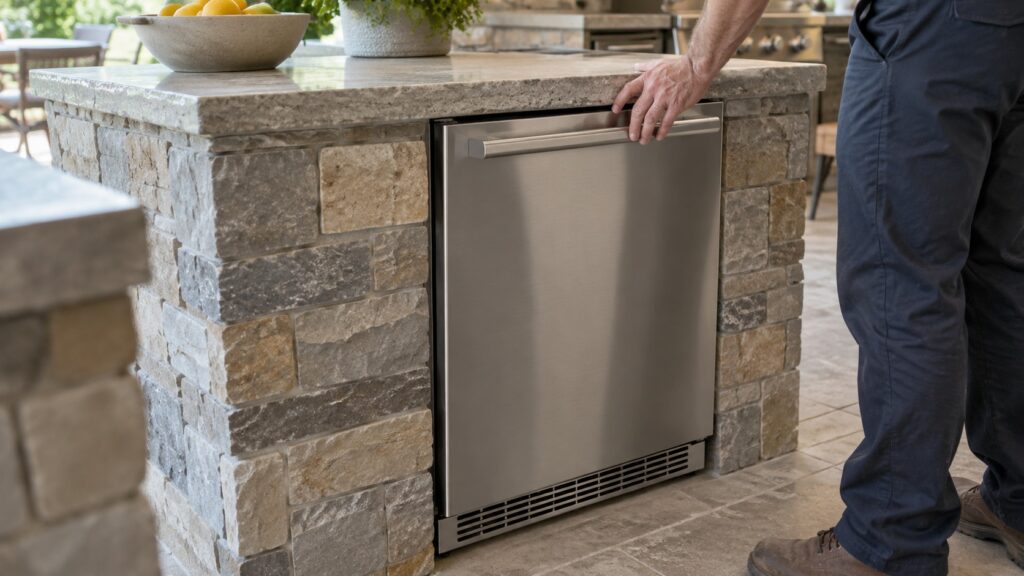
Our outdoor beverage repair vs replace guide says that door seal, fan, thermostat and ice-maker module failures are repair territory, and that a cutout that must be matched makes replacement more than a swap. A technician can replace a water valve, a fan, a seal or an ice-maker module, and the unit continues in its cutout without any carpentry or reinstallation. If the unit is otherwise sound, its finish is good and the problem is a single part, repair is nearly always the better value. A repair also keeps the unit’s matched dimensions, which is no small thing in a finished outdoor kitchen.
When does replacement make sense?
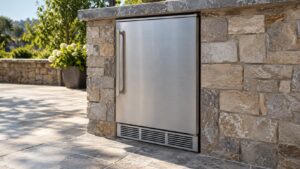
When the sealed refrigeration system has failed on an older unit and the repair estimate approaches the price of a new one; when faults keep recurring and each repair adds up; when the unit is badly corroded or damaged by a freeze; or when you are remodeling and want a different size or type. Check any replacement against the existing cutout width, depth and ventilation, because a new unit that does not match means work on the surrounding cabinets. Add the cost of removal and reinstallation. Our guide to outdoor beverage buying explains how to choose between a beverage center, a kegerator and an ice maker, and our outdoor beverage repair cost guide explains how we handle estimates.
Does winter damage change the decision?
Yes. A frozen, cracked water line or valve is a common winter casualty, as our winterizing guide explains for outdoor refrigerators, and the same principle applies to an ice maker: drain the water line before a hard freeze. A cracked line or valve is usually a repair. A unit that froze solid with water in the sealed passages or a cabinet that has been damaged by repeated freezing is a different story, and a technician should look at it before you commit to either path. In future winters, follow the winterizing steps for your model and keep the unit ventilated in summer heat.
What should you ask a technician?
Ask which part failed, whether the sealed system is involved, whether the water side is scaled or damaged, and what the unit’s overall condition is. Ask whether the replacement part is one that fits your model and what is checked before the unit is handed back. Ask how the repair compares with a replacement that fits the cutout. A written estimate before work starts makes the comparison clear, and a technician already at the unit can often tell you what else is likely to wear. Our DCS outdoor beverage repair page explains how a visit works.
How does the age of the unit factor in?
Age matters mostly because of the sealed system. A unit that has run for many outdoor seasons is more likely to have a worn seal, a tired fan and scale throughout the water side, and a sealed-system repair on such a unit invites the question of what will fail next. Our outdoor beverage repair-versus-replace guide discusses the age signal in more detail. A younger unit with a single failed part is almost always worth repairing. Be honest about how much you use the ice maker, too: a unit used every weekend in summer works harder than one that sits idle, and the wear shows accordingly.
Finally, consider what a replacement would give you. If a newer unit would offer a feature you really want, such as a different bin size or a clear-ice design, that is a fair reason to replace, but it is a decision about wants, not about a fault. Keep those two questions separate and the choice gets simpler.