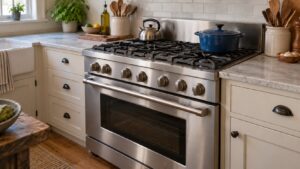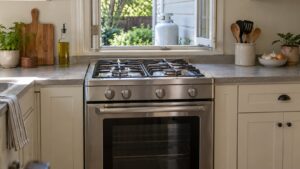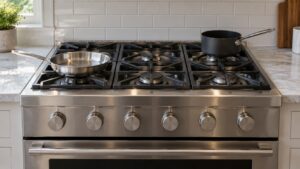
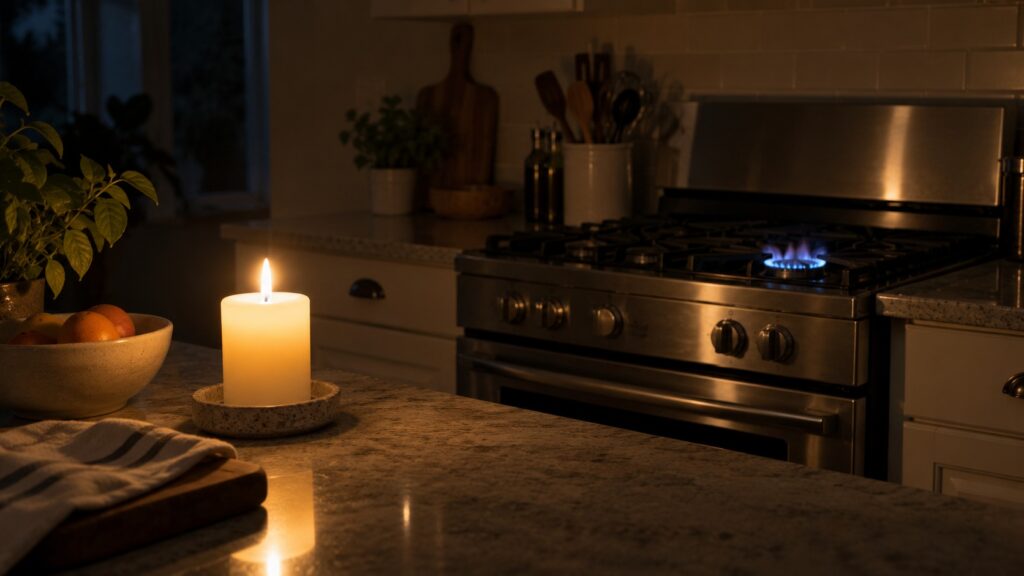
During a DCS range power outage the gas supply keeps flowing but the electricity that lights things does not, so the surface burners can usually be lit by hand with a match while the oven cannot be used. A gas DCS oven lights with an electric glow bar that must heat before the safety valve will open, and a dual-fuel oven is electric, so neither works without power. The one rule that protects your home is to turn every knob off when the power goes out, so no burner is left open waiting to spark.
Why does a gas DCS range stop working in a power outage?
A DCS range is a mechanical appliance with knobs, gas valves, igniters and thermostats, and no electronic error-code display. That makes it simple, but the igniters still need household electricity. The surface burners light with a spark from a module that runs on mains power. The oven burner is lit by a glow bar, an electric element that glows until it draws enough current to open the safety valve. With no power there is no spark and no glow, and the safety valve stays shut, which is exactly what it is designed to do.
That is not a fault. It is the range protecting you from gas flowing with nothing to light it. The gas itself is still in the line, which is why a few precautions matter in the first minutes of an outage.
What should you do the moment the power goes out?
Turn every burner knob and the oven control to the off position. If a burner was lit when the power failed, it may stay lit, and that is fine, but any knob that was turned on and did not light is now an open gas valve. If the power returns while a knob sits open, the igniter will spark and light the gas, sometimes with a puff, and in the worst case gas will have been collecting in the meantime. Going knob by knob and turning them all off takes seconds and removes the risk.
If you smell gas at any point, treat it as an emergency. Do not touch light switches, do not use a flame, leave the house, and call the gas utility from a safe place outside. Our guide to DCS gas smell safety steps explains the sequence.
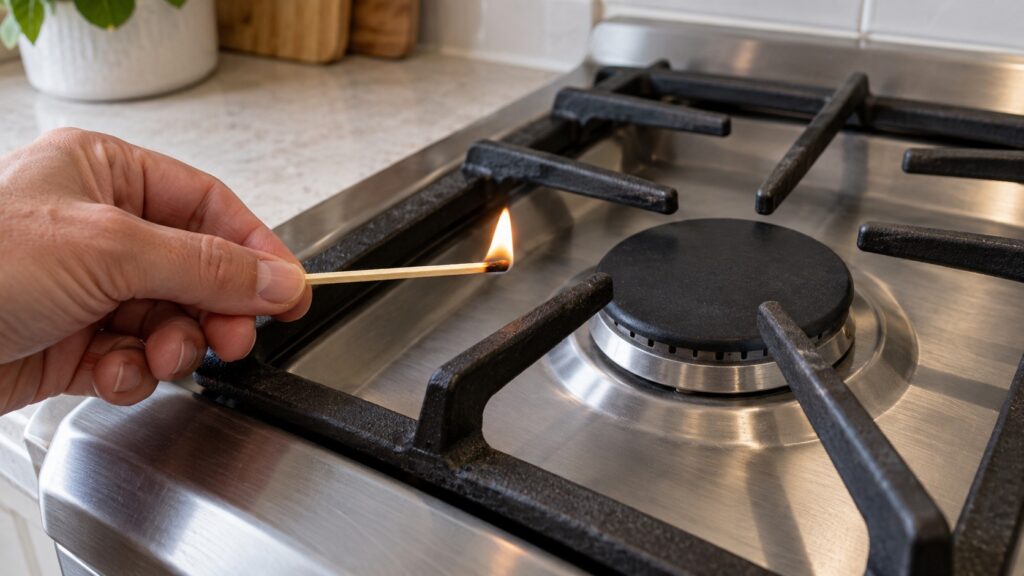
Can you light the surface burners by hand?
On most gas ranges with sealed spark-ignited burners you can. Open a window for ventilation, hold a long match or a long-reach lighter next to the burner head, then turn that burner’s knob to the High setting. The gas should catch in a second or two. If it does not, turn the knob off and wait a few minutes before trying again, because gas should never be left flowing unlit. Keep your face, hair and loose sleeves well back, and light only one burner at a time.
Check your owner’s manual for the lighting method for your model, since details can differ between ranges. Use low heat settings and attend the pan, and never use a gas range as a heater. The burner will respond to the knob normally once lit. Keep in mind that the range hood will not run without power, so ventilate with windows if you cook for a while.
Why can’t you use the oven?
The gas oven burner is lit by the glow bar, and the safety valve will not open until the bar is hot enough. Without power the bar never heats, so the valve stays closed and the oven stays cold. Do not try to light the oven burner by hand with a match, because the safety design is meant to prevent exactly that, and gas can accumulate in a closed oven cavity. A dual-fuel DCS range has an electric oven, which needs power in any case. Our glossary of DCS glow bar and igniter terms explains the parts.
If you need to cook during an extended outage, use the surface burners, an outdoor grill used outdoors or another safe method, not the oven.
What should you check when the power comes back?
Once the power returns, check that all knobs are off, open a window if you smelled anything, and then light one burner normally. It should click and light within a couple of seconds, and the clicking should stop when the flame appears. Test each burner in turn, then try the oven on a low bake setting and confirm the glow bar glows and the burner lights. A surge can occasionally upset the spark module or the oven controls, so watch for a burner that keeps clicking or an oven that stays cold.
If a burner clicks continuously, see our guide to the continuous clicking problem, and for an oven that glows but will not light, read DCS oven not heating. Anything that involves a gas smell, a part that will not light after a reset, or a burner that lights with a delay needs DCS range repair.