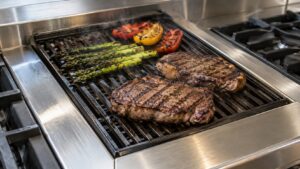
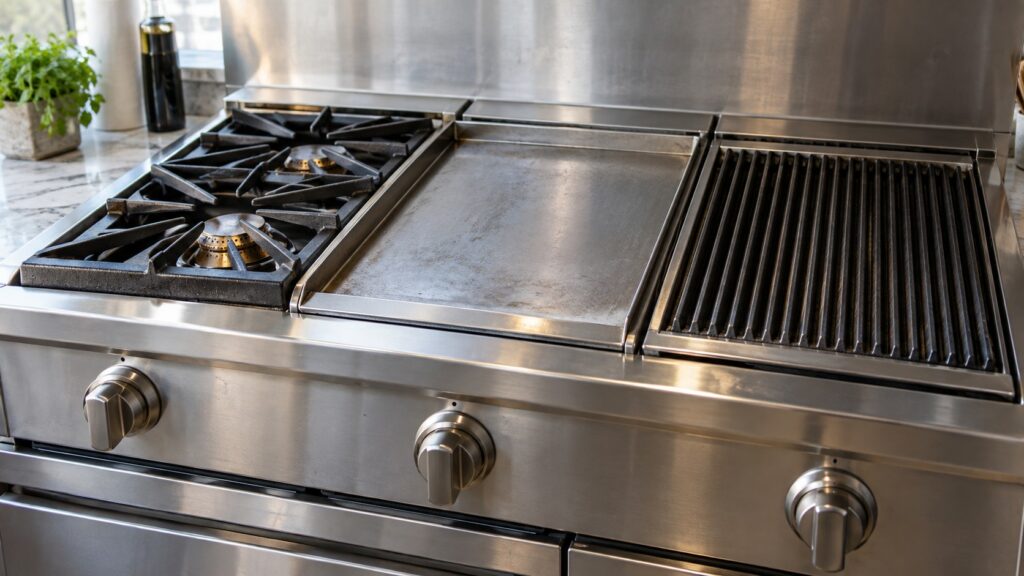
A DCS rangetop module is a swappable cooking insert — a grill module, a griddle module, or a wok ring — that drops into one of the burner bays on a DCS rangetop panel in place of a standard open burner. The rangetop itself (the CPV2 and VRT series) is built with one or more bays sized to accept these modules, which is what lets one rangetop cook like a grill, a flattop and a wok station without three separate appliances. Confusing the module with the rangetop, or with a DCS grill’s own grill head, is the single most common source of mismatched parts orders.
What does “module” mean on a DCS rangetop?
On a DCS rangetop, a module is any insert that replaces a standard sealed burner in one of the rangetop’s bays. Each bay is built to the same footprint, so a grill module, a griddle module or a wok module can be swapped into the same position depending on what you are cooking that day. The module brings its own cooking surface; the bay underneath supplies the gas and the ignition. This is why a rangetop’s spec sheet lists both a burner count and a module option — the two numbers describe different things, and understanding DCS rangetop modules before ordering parts is what keeps a swap from turning into a mismatch.
How is a rangetop module different from a DCS grill head?
A grill head is the entire cooking chamber of a standalone DCS outdoor grill — the box, the burners, the grates and the hood, covered in our grill head glossary entry. A rangetop grill module is much smaller: it is only the cooking surface insert that sits inside one bay of a rangetop panel, with no hood or enclosure of its own. The two share a name because both put grill marks on food, but they are not interchangeable parts, and a part ordered for one will not fit the other.
What is inside a griddle module, and why does it heat unevenly if neglected?
A griddle module is a solid metal plate over the bay’s burner, heated from below rather than by open flame contact. Because the whole plate relies on one burner’s flame pattern for even heat, a burner running with a partially blocked port, or a griddle surface with a buildup of seasoning in one spot, produces a plate that runs hot in the center and cool at the edges. Our griddle care guide covers the cleaning routine that keeps that heat pattern even.
How does a wok module hold a round-bottom pan over a flat rangetop?
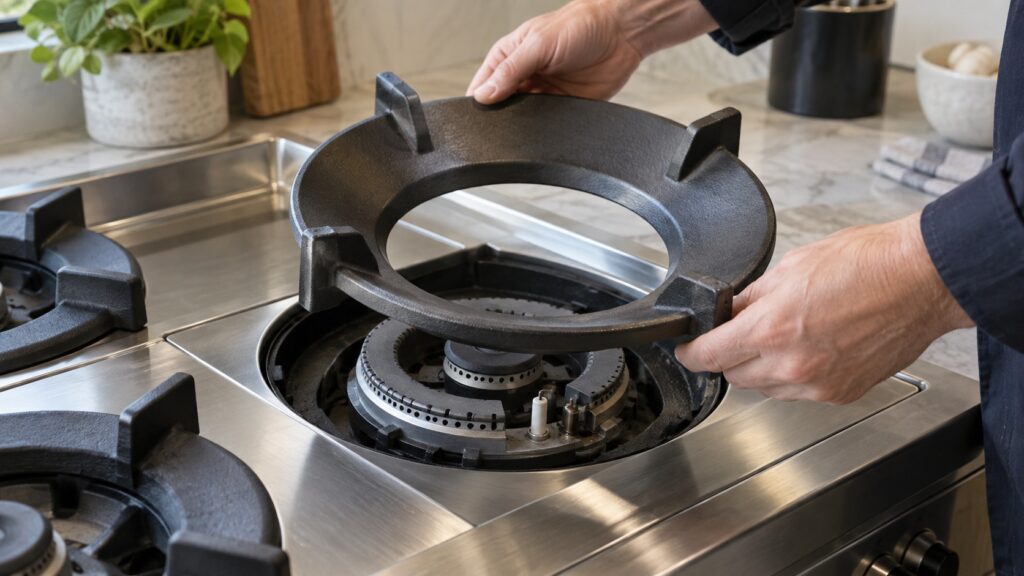
A wok module replaces the flat grate of a standard burner with a ring stand shaped to cradle a round-bottom wok directly over the flame, instead of the flat-bottom pan support a sealed burner normally uses. This puts the flame closer to the pan’s curved surface than a standard burner grate would allow, which is the point — wok cooking depends on very high, direct heat at the base of the pan. Because the ring sits lower and closer to the burner than a flat grate, it also collects more spillover, which is the usual cause of a wok module burner that will not ignite cleanly.
Which rangetop models take which modules?
Module compatibility is set by the rangetop’s bay layout, not by the model name alone — the CPV2 series and the VRT series are configured with different bay counts and module options depending on width. Before ordering a module, confirm the exact model number on the rating plate rather than assuming by width; two rangetops of the same width can ship with different bay configurations depending on when they were built. Our rangetop installation requirements guide covers where to find that plate and what else to check before a module swap.
What should I do if a module bay will not ignite?
Start by removing the module itself and cleaning the burner port underneath — spillover from a griddle or wok module is the single most common cause of a bay that will not light, covered case by case in our rangetop grill module troubleshooting page. If the bay ignites without a module but the module’s own surface will not heat evenly, the module itself, rather than the rangetop, is usually the part at fault. Our rangetop troubleshooting tips cover the wider set of ignition issues across all bay types.
Keep the modules themselves separated by type when storing a spare — a griddle plate stacked directly on a grill grate can scratch the griddle’s cooking surface, and a wok ring left resting on its thin edge can bend slightly out of round. None of that damage shows up immediately, but it changes how evenly a module sits in its bay the next time it goes in, which is a second, less obvious source of the uneven heating this section covers.
Do all DCS rangetop modules use the same size burner?
No. A grill module’s burner is typically rated for higher output than a griddle module’s, because a grill surface needs to sear directly through open grate slots while a griddle spreads the same heat across a solid plate. A wok module sits in between, since the ring shape concentrates flame at the pan’s base rather than spreading it. This is another reason a module ordered for the wrong bay size, even on the same rangetop, will not perform the way the manufacturer’s spec sheet describes — the burner underneath and the module on top are matched as a pair, not interchangeable independently of each other.
We are an independent repair company, not a factory service arm, and we source replacement modules from reputable supply channels rather than claiming any factory affiliation. DCS rangetop repair covers module bays, burners and igniters, and pricing starts from a diagnostic visit with the estimate confirmed before any work begins. Schedule a visit online or call 1-844-487-0065.