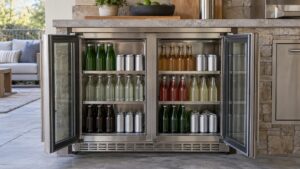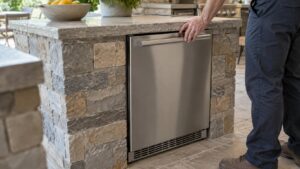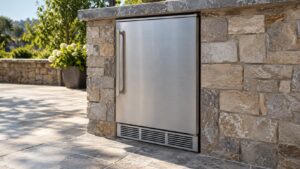
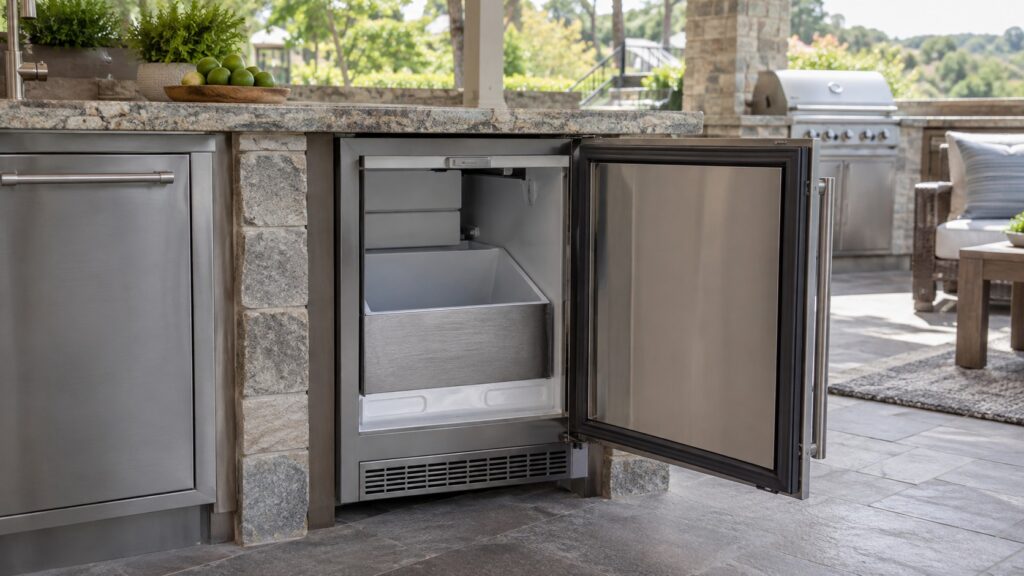
A DCS outdoor beverage center ice maker that stops making ice, or that makes small hollow cubes instead of full ones, is almost never a sign that the whole unit is failing. The ice maker in these units is a self-contained module bolted into the cabinet, and most calls trace back to water supply, airflow around the module, or ambient heat rather than a burned-out motor. Before assuming the worst, work through the module itself, the water line feeding it, and the conditions it is running in.
Why is a DCS outdoor beverage center ice maker not making ice?
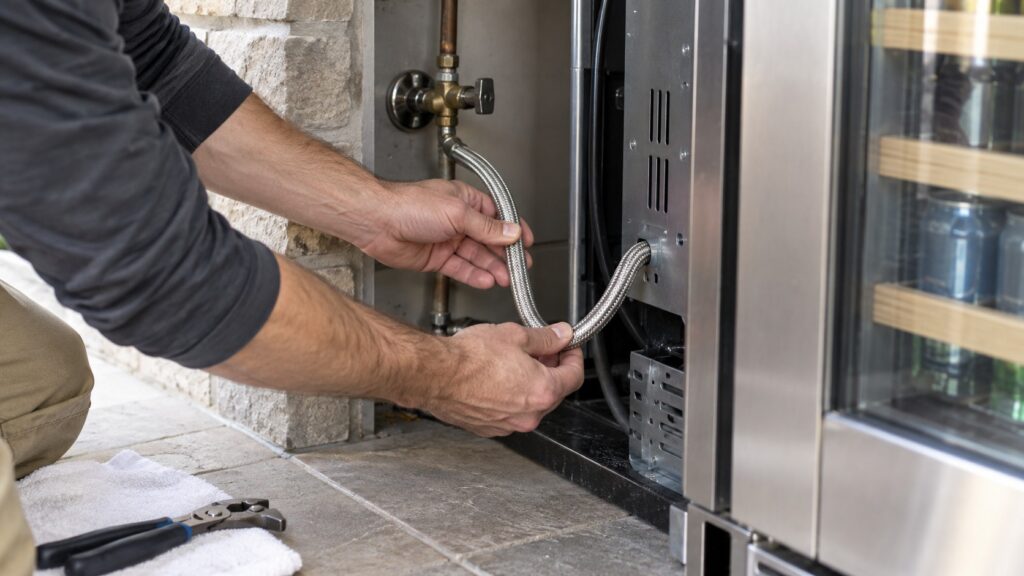
Start with the simplest explanation before opening anything. The module has its own on/off toggle separate from the cabinet’s cooling controls, and it gets bumped or intentionally switched off more often than owners remember. If the toggle is on and the bin is empty, follow the water line back to its source. Outdoor lines run through masonry, decking, or exterior walls, and a kink or a freeze point upstream of the cabinet will stop water from ever reaching the module, even though every part inside the unit is working correctly.
If water is reaching the unit, the fill valve itself is the next stop. A valve that hums but does not open, or opens partway, produces the same symptom as no water at all: an empty ice tray and a harvest cycle that keeps trying and failing.
What causes small or hollow ice cubes?
Small or hollow cubes are a water-volume problem, not a temperature problem. The mold cavities need a full, steady fill to freeze solid cubes; a partial fill freezes only the outer shell before the cycle moves on, leaving a hollow center. The two most common causes outdoors are mineral scale narrowing the fill tube over a season of hard water, and low incoming pressure on a long or elevated supply run. Neither is dangerous to leave for a few cycles, but both get worse, not better, until the line or the valve is cleared.
Is this ice maker the same as the one in a DCS outdoor refrigerator?
No, and that distinction matters when you are reading about codes online. DCS outdoor refrigerator cabinets (the RF24RE and RF24DE lines) use a sealed-system ice maker that reports specific fault letters — IF, IM and IW — through the cabinet’s own display, covered in our outdoor refrigerator ice maker code guide. The ice maker in an outdoor beverage center (the RF24IM and RF24BC series) is a simpler standalone module without that code display; it reports failures as a symptom you can see — no ice, small ice, or a slow harvest — rather than a letter on a screen. Diagnosing one with the other’s code list will send you looking for a display that is not there.
How do outdoor heat and humidity change the diagnosis?
An outdoor beverage center works harder than an equivalent indoor unit, and the ice maker is the first component to show it. On a hot afternoon, a condenser coil that is even partially blocked by cottonwood, pollen, or dust cannot reject heat fast enough, and the ice maker’s harvest slows or stops as an indirect result — the compressor is prioritizing keeping the cabinet’s set temperature over freezing a fresh batch. If the slowdown tracks the hottest part of the day and recovers by evening, clean the coil before assuming the module has failed. A door that will not seal flush compounds the same problem: it lets in humid outside air, and that moisture load falls partly on the ice maker’s evaporator.
What should I check before calling for service?
- Confirm the module’s own power toggle is on, separate from the cabinet’s cooling switch.
- Trace the water line from the shutoff to the unit for kinks, a frozen section, or a fitting that was never fully seated.
- Check the door seal for a gap you can see daylight through, especially at the hinge side.
- Look at the condenser coil through the base grille and clear visible debris with a soft brush, not a hose.
- Dump and refill the bin once — a batch of hollow or fused cubes sometimes clears on its own once fresh water and a full pressure cycle reach the mold.
None of these steps require opening the sealed refrigeration system or the fill valve housing, and none of them should take more than a few minutes with the unit’s own access panel. Keep a simple log of when the problem shows up — first thing in the morning, only on the hottest afternoons, or every time regardless of weather — because that pattern is often the fastest way to tell a water-supply problem from a heat-driven one before a technician ever arrives. A unit that only struggles between noon and early evening in summer is pointing at the condenser coil and ambient heat load; a unit that struggles at every hour, including cool mornings, is pointing at the water line or the fill valve instead.
When does this become a repair call instead of a fix-it-yourself job?
Book a visit when the water line and door seal both check out clean and the module still will not harvest, when the harvest cycle runs but nothing collects in the bin, or when the same small-cube pattern returns within a day of a full bin dump. Those point at the fill valve, the harvest thermostat, or the module’s own control board — parts that need a multimeter and, on some models, replacement of the sealed module rather than a single part. Our outdoor ice maker no ice and small ice pages walk through the same checks with photos if you want to confirm before scheduling. A related seal problem is covered in outdoor beverage center door seal, and if you are still deciding between a standalone ice maker unit and a kegerator for the same footprint, our beverage chiller vs. kegerator guide covers that choice.
We are an independent repair company, not a factory service arm, and we will tell you when the fix is a coil cleaning rather than a parts order. Pricing starts from a diagnostic visit and we confirm the estimate before any work begins. DCS outdoor beverage center repair covers ice makers, fill valves and door seals, and you can schedule a visit online or call 1-844-487-0065.