A DCS glow bar is the electric igniter inside a gas oven: it heats until it glows, and only when it draws enough current does the safety valve open and let gas reach the oven burner. That one sentence explains why a gas oven with a tired glow bar glows faintly and never lights. DCS ranges, rangetops and grills are mechanical appliances with knobs, valves and igniters, not control boards, so they report trouble as symptoms rather than codes. This glossary explains the ignition and gas safety words you will meet when you troubleshoot one.
What is a glow bar on a DCS oven?
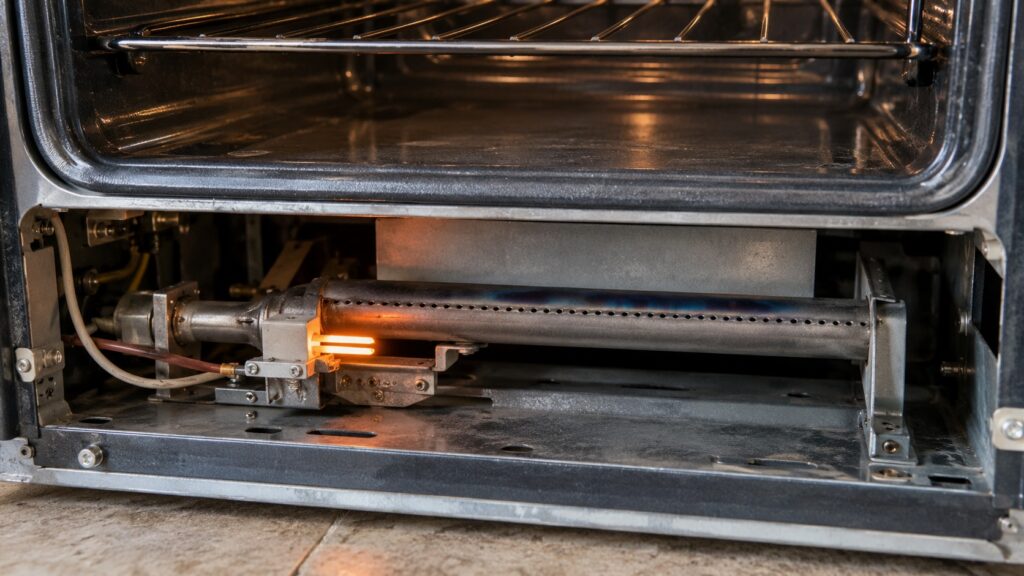
The glow bar, sometimes called a glow plug or a hot-surface igniter, is a small ceramic element in the bottom of a gas oven. When you set the oven to bake, current heats the bar until it glows orange. The bar is wired in series with the gas safety valve, so the valve will not open until the current through the bar is strong enough, which proves the bar is hot enough to light the gas.
These bars weaken with age. A weak one still glows, but it draws too little current to open the valve, so you see the glow and no flame. That is the standard reason a gas DCS range oven stays cold while the burners on top work. Our guide to DCS oven not heating walks through the other causes, including a failed bake element on dual-fuel models.
What does the oven safety valve do?
The safety valve is the gate between the gas line and the oven burner. Its job is to stay shut unless the igniter proves itself, so raw gas can never flow into a cold oven. When the glow bar is hot enough, the valve opens, the burner lights, and the flame continues. If the valve is stuck, or the bar is too weak, the oven stays cold. A brief gas smell that clears on a gas oven is a sign gas leaked through before ignition, and it deserves attention.
Never try to defeat or prop open a safety valve. If you smell gas that does not clear, leave the area, do not touch light switches, and call the gas utility from outside. Our guide to DCS gas smell safety steps explains what to do.
What are the spark module and the electrode?
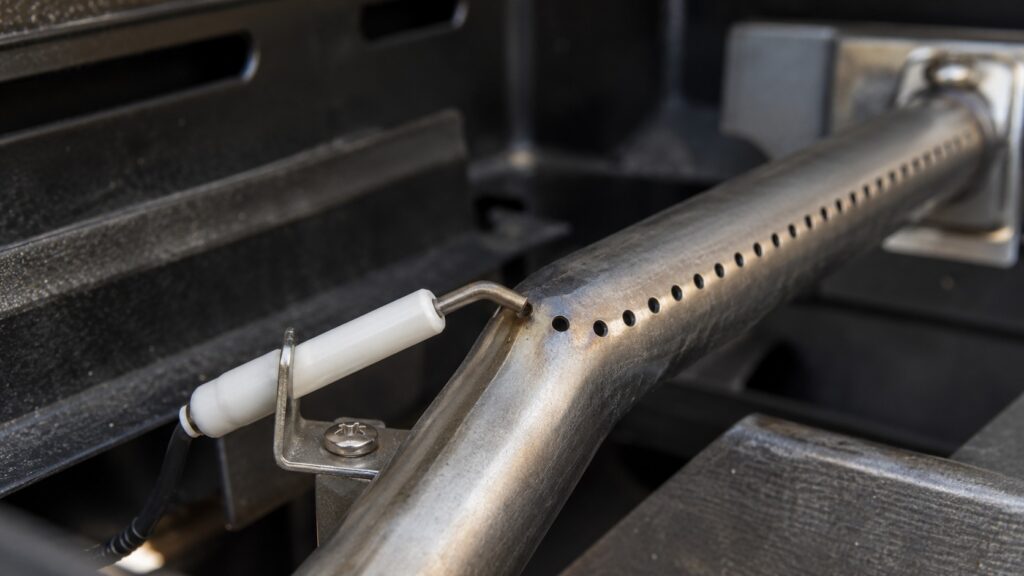
On the cooktop burners and on grills, ignition is by spark. The spark module is the small box that builds a high-voltage pulse, and the electrode is the tip that pulse travels to through an insulated wire. The electrode sits a fraction of an inch from a burner port, and the spark has to cross that air gap to the grounded burner while gas is flowing. The clicking you hear is the module firing, whether or not the spark reaches the gap.
The white ceramic around the electrode is the weak point. Moisture or baked grease across it can carry the pulse away before it crosses the gap. That is why a grill may click without lighting on a damp morning. For the full sequence on a grill, see DCS grill igniter troubleshooting, and for a range that will not light a burner see the guide to range burner ignition.
What is the gap, and why does it matter?
The gap is the small space between the electrode tip and the burner. Too wide, and the spark looks for an easier path and jumps to a screw or the burner casting, where there is no gas. Too narrow, and the electrode shorts to the burner, and you hear a click with no visible spark. Gaps drift over seasons as burners heat and cool and as brackets loosen, so an igniter that once worked can slowly stop.
Setting a gap is a small job, but it is done with the gas off and the burner cool, and a bent tip is straightened gently, not replaced. If you are not comfortable, leave it to a technician.
What are the crossover tube, venturi and orifice?
These are the parts that move gas and flame inside a grill burner. The orifice is the small opening that meters gas into the burner tube. The venturi is the throat of the burner tube where gas mixes with air, and a spider nest here is the classic reason a grill burner will not light or burns weakly. The crossover tube lets a lit burner pass its flame to the next one, so you only need to spark one end. When a burner stays dark while its neighbor burns, a blocked crossover or port is a common cause.
Keeping the ports and tubes clear is plain maintenance, covered in our guide to DCS grill burner cleaning. The rotisserie burner at the rear has its own igniter and valve, as our entry on the rotisserie burner explains.
What is regulator bypass on an LP grill?
An LP grill regulator has a safety feature that limits gas flow when it senses a sudden surge, such as when a cylinder valve is opened quickly. In that state the grill gets only a trickle: burners light, then shrink, or one burner drops out. The usual fix is to turn all grill knobs off, close the cylinder valve, wait a minute, and open the cylinder valve slowly. If the flame still will not hold, check for a low cylinder, a blocked port or wind.
This is easy to confuse with an igniter fault, because the burner may light and then die. The ignition has done its job, and the problem is the gas supply.