
Every draft system grows a biofilm inside its lines. It is not a sign of neglect and it is not avoidable — yeast, protein and sugar from the beer itself build a living layer on the tubing walls within days. DCS beer dispenser cleaning is the routine that removes it, and it is the difference between a kegerator that pours the beer you bought and one that pours something sour, cloudy and faintly of the keg before last.
What is actually growing in there
Two different deposits form, and they need two different chemistries — which is why a system cleaned faithfully with one solution can still pour badly. The first is organic: yeast, proteins and hop resins that form a soft film on the tubing wall. A caustic line cleaner dissolves that, and it is what most people mean by cleaning lines.
The second is beer stone, a mineral scale of calcium oxalate that builds slowly and is unaffected by caustic. It needs an acid cleaner, and twice a year is the usual interval. A system that has never had an acid clean will eventually taste off no matter how often it sees caustic, and the owner concludes the appliance is at fault.
The routine, in order
- Disconnect the keg and relieve the pressure. Nothing here happens under gas.
- Push cleaning solution through with a pump or a pressurized cleaning keg until it runs from the faucet, then leave it to dwell for the time the product specifies — usually fifteen to twenty minutes.
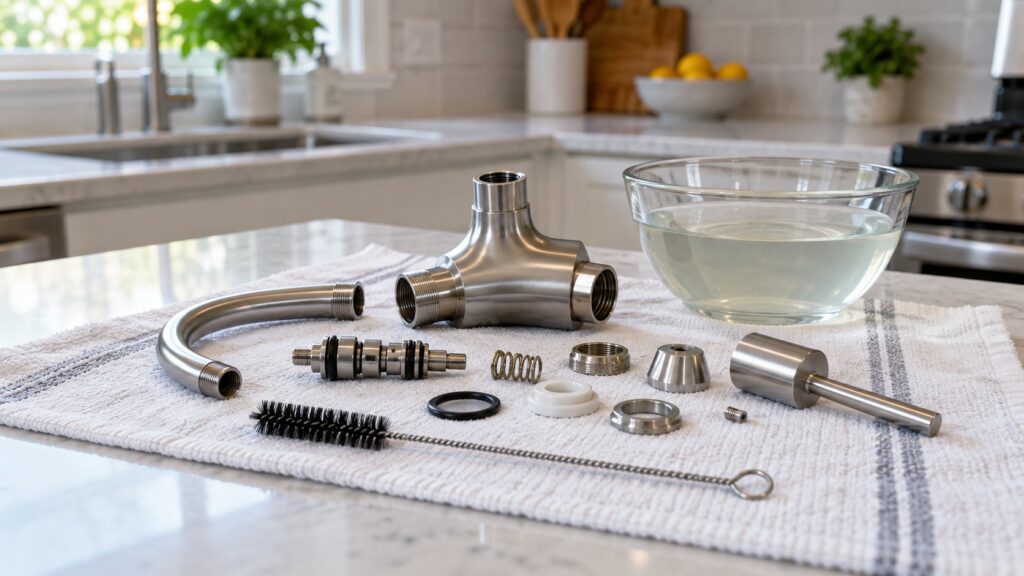
- Take the faucet apart while that dwells. Soak the parts, brush them, rinse them. The spout and the internal lever assembly are where most of the visible growth lives.
- Rinse thoroughly with clean water until no trace of cleaner remains. 🔴 This is the step people cut short, and residual caustic ruins the first pints and is not good for anyone.
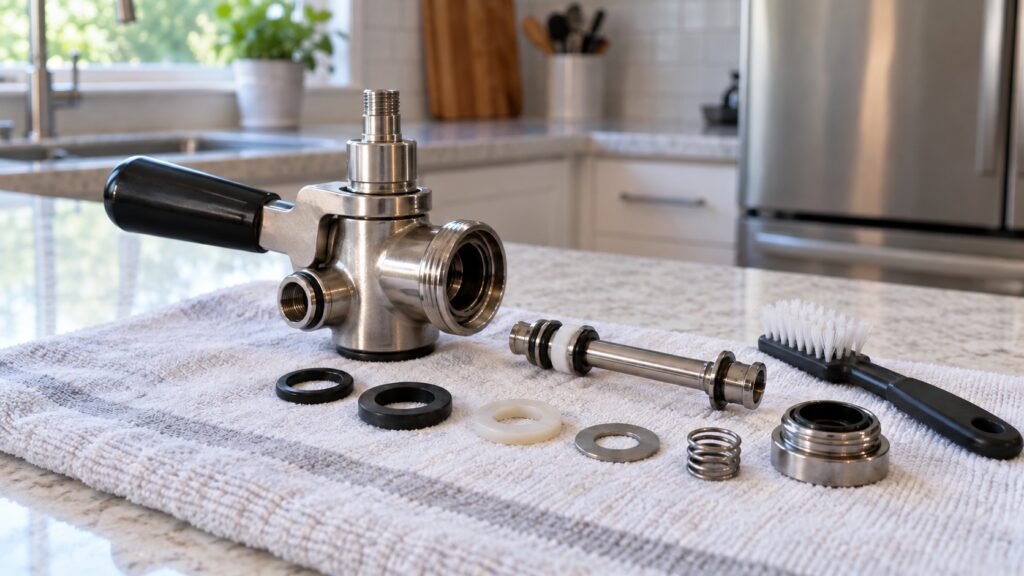
- Clean the coupler separately — soak, brush, rinse — before reconnecting.
- Reconnect and pour off the first glass or two.
The coupler is the part everyone forgets
It sits on top of the keg, it is out of sight, and it collects everything that foams back up the line. A coupler that has never been cleaned will contaminate a freshly cleaned system the moment it is reconnected, which is why people sometimes clean their lines and taste no improvement at all.
Take it apart at every keg change. The washers and the probe come out, soak and brush easily, and go back in a minute. Replace the washers when they harden — a coupler that no longer seals cleanly is also a coupler that lets the keg go flat.
What bad beer is telling you
- Sour or vinegary — bacterial growth in the lines. Caustic clean, and shorten the interval.
- Cloudy or with floaters — biofilm breaking loose. Clean, then clean again a week later.
- Metallic or astringent — often beer stone rather than the beer. Acid clean.
- Endless foam — usually not cleanliness at all: temperature, CO2 pressure or line length. See our temperature guide and CO2 setup guide.
What you need to do it, and what it costs
The equipment list is short and it is a one-time purchase: a cleaning kit with a hand pump or a small pressurized cleaning keg, a faucet brush, a bucket, eye protection, and the two chemistries. Total outlay is modest against the cost of a keg, and a keg spoiled by dirty lines costs more than the kit did.
Time is the real cost, and it is less than people fear. A full line clean is about half an hour of which twenty minutes is dwell time you spend cleaning the faucet anyway. Set it against the alternative — an appliance that quietly stops being used because the beer is no longer nice — and it is the cheapest maintenance in the outdoor kitchen.
Line length, and why it is not arbitrary
The tubing between keg and faucet is sized to balance the CO2 pressure pushing the beer against the resistance of the line. Too short and beer arrives too fast and foams; too long and it pours slowly and flat. That balance is also why cutting a line shorter to tidy an installation is a bad idea, and why replacing tubing with whatever is on the shelf changes how the system pours.
Keep a note of the line length and internal diameter that came with the unit, and match it when tubing is replaced. Tubing is a consumable — after enough cleaning cycles it clouds, softens and starts holding flavor, and at that point replacement is more effective than any amount of further cleaning.
Products, and the three that ruin a system
Use a cleaner made for beer lines. The three substitutes people reach for all cause damage. Dish soap leaves a residue that kills head retention permanently until the lines are replaced. Bleach corrodes stainless components and leaves chlorine flavors that never fully clear. And vinegar, while acidic, is far too weak for beer stone and strong enough to taint the tubing.
Wear eye protection with caustic solution and keep it off the stainless exterior of the cabinet, where it will mark the finish.
When the system is shut down
A kegerator going out of use for a season should be cleaned before it is switched off, not after. Lines left with beer in them for months are a far harder job than lines left clean and dry, and in a freezing climate they are also the lines most likely to split. Our winterizing guide covers the drain-down.
When to call
Cleaning is an owner’s job, and nothing in this guide needs a technician. What does is a unit that will not hold its temperature, a compressor that runs constantly, a cabinet that has iced up, or a CO2 system that will not hold pressure with fresh washers. Those are the appliance rather than the routine.
We are an independent repair company, not a factory service arm. Pricing starts from a diagnostic visit and we confirm the estimate before any work begins. DCS outdoor beverage repair covers refrigeration and dispensing, and you can schedule a visit online. If you are still deciding between formats, our chiller against kegerator guide is honest about exactly this routine.