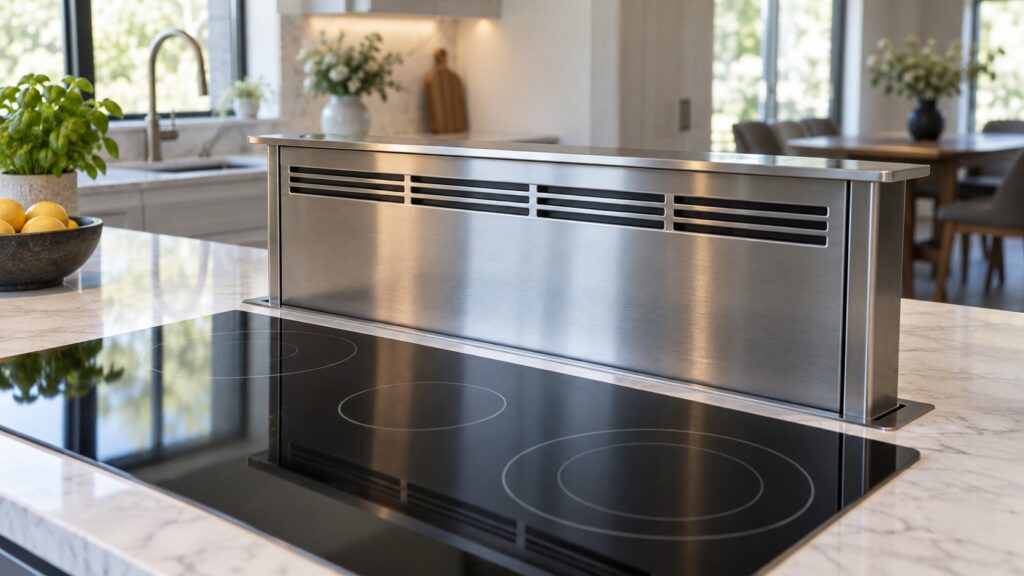
A DCS downdraft is ventilation that works against physics rather than with it. An overhead hood catches smoke and steam as they rise; a downdraft has to capture the same plume at counter level and pull it sideways and down before it escapes. That it works at all is a matter of airflow, proximity and how you cook — and understanding those three explains both why people love downdrafts and why some are disappointed by them.
What the mechanism is doing
Hot air rises, and a cooking plume rises fast — faster the hotter the pan. A downdraft has to generate enough inward velocity at the intake to overcome that rise within the few inches where the plume is still coherent. Beyond that distance the plume has dispersed into the room and no amount of fan will bring it back.
That is why the two design variables are proximity and airflow rather than raw power. A telescoping downdraft that rises several inches above the counter is not doing it for looks — height puts the intake into the plume rather than below it. The same unit lowered flush captures far less, which is why leaving it down to save the view defeats the appliance.

Where a downdraft is genuinely the right answer
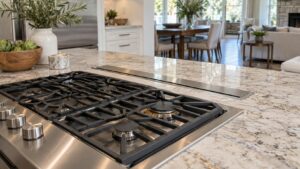
An island cooktop with a view across it, an open-plan room where a hood would dominate, a ceiling with a structural beam or a floor above that cannot be ducted, a low ceiling where an overhead hood would be at head height — these are the cases where a downdraft is not a compromise but the correct choice.
It is also the right answer where a hood would have to be so tall to clear sightlines that its own capture would suffer. A hood mounted too high is a poor hood, and a downdraft close to the pan beats a hood far from it. Our guide on how DCS range hoods work covers the overhead alternative.
Cooking style decides how well it performs
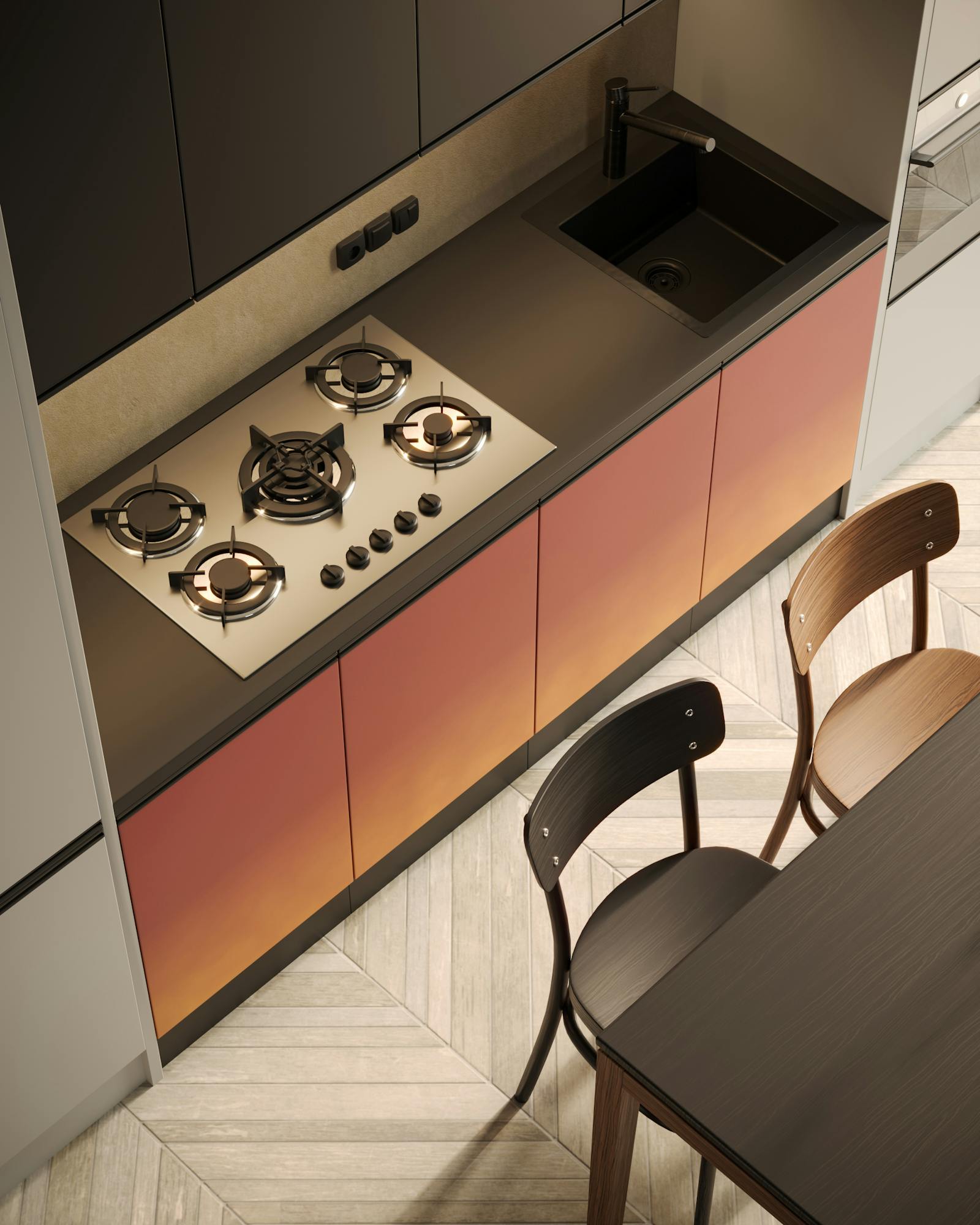
- Use the rear burners for anything that smokes. On most layouts the intake is behind the cooktop, and a rear pan is inches from it while a front pan is a foot away.
- Tall pots are the hard case. A stock pot puts its plume above the intake before the intake can act on it. Nothing fixes this except a lid or a different burner.
- Raise it fully, every time. A telescoping unit left half up is working at a fraction of its capture.
- Switch it on before you start rather than when the room fills. Capture works on a forming plume, not on a dispersed one.
Ducting is where performance is won or lost
A downdraft ducts down through the cabinet and then horizontally, usually through a floor or a joist bay, which is a longer and more convoluted route than an overhead hood’s. Every elbow costs airflow and a long run can halve the figure on the box — and a downdraft has less margin to lose than a hood does, because it is already fighting the plume’s direction.
Rigid duct, the shortest route available, the fewest turns, and a termination with a flap rather than a mesh screen. A screen at the exterior cap blocks with lint and grease within months and is the most common hidden restriction we find. Our downdraft installation guide covers the run in detail.
Recirculating is a different appliance
Where ducting to the outside is impossible, a downdraft can be run recirculating through charcoal filters. It is worth being clear about what that does and does not achieve: it removes odor and some grease, and it does not remove heat or moisture. Steam stays in the room and so does the warmth.
In a large open-plan room that is often an acceptable trade. In a small closed kitchen it is not, and people who make that choice to avoid a duct run frequently regret it in the first winter, when the windows run with condensation.
Make-up air, and the rule people meet late
Any ventilation moving a large volume of air out of a sealed modern house has to have that air replaced, and above a certain airflow that replacement has to be provided deliberately rather than left to leak in around windows. A downdraft is no exception, and because it is often chosen for a large island with high-output burners, it frequently lands above the threshold.
Without make-up air, a powerful vent depressurizes the room, and the consequences are not subtle: doors that pull shut, a fireplace that smokes back into the room, and combustion appliances elsewhere in the house that can backdraft. This is a safety matter rather than a performance one, and it is far cheaper to plan at the framing stage than to retrofit.
What goes wrong
The mechanism is a blower, a motor for the telescoping section, filters and controls. Weak capture is nearly always a filter that has not been cleaned or a duct restriction rather than a failing blower. A section that will not rise is the lift motor or something jamming it — usually a spill that has dried in the track. Noise that has grown gradually is a blower bearing; noise that appeared suddenly is something loose in the airway.
Filters go in the dishwasher on a schedule, and the schedule is shorter than people expect if you sear regularly. Our filter cleaning guide applies here too.
When to call
A blower that will not start, a section that will not rise, a unit that trips its circuit, or capture that has fallen off suddenly rather than gradually — those are the appliance. Gradual decline with clean filters points at the duct.
We are an independent repair company, not a factory service arm. Pricing starts from a diagnostic visit and we confirm the estimate before any work begins. DCS ventilation repair covers downdrafts along with overhead hoods, and you can schedule a visit online.