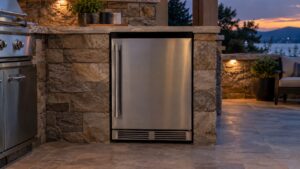
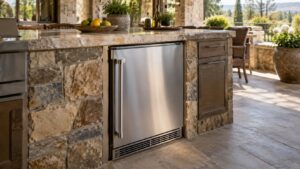
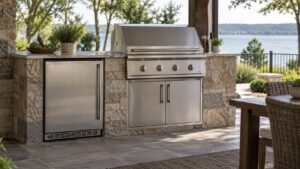
How DCS outdoor refrigerators work
Professional DCS outdoor refrigerator repair covers the brand’s 24″ UL outdoor-rated refrigerators and refrigerator drawers, built by Fisher & Paykel company DCS for the outdoor kitchen. Unlike the mechanical grills and cooktops in the lineup, these units run on Fisher & Paykel ActiveSmart electronics, which means they genuinely report digital error codes — the abbreviation codes a technician reads on the diagnostic display. The RF24RE door model and the RF24DE drawer model are engineered to hold temperature in outdoor heat, with a sealed refrigeration system, an evaporator fan, and Rapid Cool-Down. Because the controls are electronic, diagnosis combines reading the displayed code with sealed-system and electrical testing rather than guessing from symptoms alone.
ActiveSmart error codes
The ActiveSmart system uses two-letter abbreviation codes that point directly at the affected subsystem. CL means the cabinet is running too cold and CH means it is too warm; FL and FH flag a refrigerated section reading too cold or too warm; RL indicates a refrigerator-section sensor failure. Door failures appear as DL (door left open) and DS (door switch failure). On units with ice, IM flags an ice-maker problem, IF an ice-full or ice-maker condition, and IW the ice/water valve circuit. FS calls for filter service or a sensor check, AL is a general alarm, HL a high-limit condition, and CM a communication error between control boards. Numbered “Problem” codes are internal LED-flash diagnostics read by a technician. Our outdoor refrigerator error-code guides explain each code in detail.
Common DCS outdoor refrigerator repair problems
The most frequent calls involve a cabinet that runs too warm (CH or FH), a cabinet that runs too cold (CL or FL), door alarms (DL/DS), ice-maker and water-valve failures (IM/IW), and communication errors (CM). A CH or FH condition is traced to a weak compressor, a low refrigerant charge, a blocked condenser, or restricted airflow on an outdoor install. Sensor failures such as RL are confirmed by testing the thermistor and harness against spec. A CM communication error points to a damaged or corroded outdoor connector or a failed board, isolated by testing each board in turn. Even without a displayed code, a compressor that will not maintain temperature is diagnosed for start-device, sealed-system, and relay failures. Most DCS outdoor refrigerator repair jobs are resolved in a single visit once the displayed error code and the underlying component are confirmed.
Maintenance for outdoor refrigeration
Outdoor refrigerators work hardest in summer heat, so maintenance focuses on letting the sealed system shed heat. Vacuuming the condenser and keeping the surrounding vents clear of leaves and debris prevents the CH and FH warm-cabinet codes that a blocked condenser triggers, and confirming the unit has the clearances its UL outdoor rating requires keeps airflow adequate. Cleaning the door gasket and checking it seals flush avoids DL door alarms and the constant running that follows a poor seal in outdoor heat. On units with ice, replacing the water filter on schedule heads off FS service prompts and IW valve failures, and a clear water line prevents freeze-related ice-maker problems. Because the outdoor connectors are exposed, keeping them sealed reduces the CM communication problems that corrosion causes. Our model pages list the boards, fans, and thermistors for each RF24 build.
Service, parts, and warranty
Repairs use genuine OEM compressors, fans, thermistors, door switches, valves, and ActiveSmart control boards matched to the model. Our certified technicians cover all 50 states and 120+ metro areas, and the booking form accepts requests 24/7, with same-day visits where availability allows. Diagnostic visits start from $129; the final cost depends on the parts and the unit involved. Specifications and the current outdoor refrigeration lineup are published by the manufacturer at dcsappliances.com. For outdoor beverage and ice units, see our outdoor beverage storage repair page.