
How DCS wall ovens are built
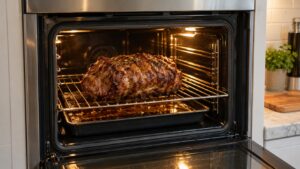
Expert DCS oven repair covers the brand’s built-in wall ovens — single and double, all with convection — built by Fisher & Paykel company DCS from 304-grade stainless steel. The WOV, WOSV, WODV, and WOU families share a convection design in which a fan circulates heated air for even, faster cooking across multiple racks. A wall oven installs into cabinetry on its own dedicated circuit, so its service is self-contained: the bake and broil elements, the convection element and fan, the temperature sensor, the door and gasket, and the control electronics. Double-oven WODV models effectively contain two independent cavities, each with its own elements, sensor, and relays, so a problem in one cavity does not mean both need work.
Heating and convection technology
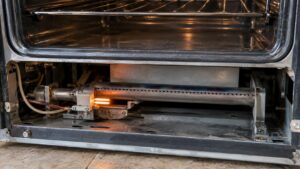
The bake and broil elements are resistive heaters switched by control relays; the convection element and fan add circulated heat for even results. A temperature sensor feeds the control, which holds the cavity at the set point. DCS wall ovens report most problems as symptoms rather than a stream of coded problems — an oven that won’t heat, a temperature that runs off, a self-clean cycle that stays locked — and a technician isolates the cause with component-level testing: continuity on the elements, resistance on the sensor, and relay operation on the board. Calibration is always verified against a reference thermometer. Our oven symptom guides explain each issue, and broader maintenance tips live in our guides library.
Common DCS oven repair problems
The most frequent oven repairs are an oven that won’t heat, a temperature that runs off the set point, slow preheat, a dead broil element, a convection fan failure, uneven baking, a door that won’t seal, and a self-clean cycle that stays locked. An oven that won’t heat usually traces to a failed bake element showing a visible break, a tripped hi-limit thermostat, or a control relay not energizing the element. Slow preheat and heat loss point to a worn door gasket or weak hinge springs. On double ovens, isolating which cavity has failed narrows the diagnosis quickly. Controls that reset or freeze are tested at board level for relay and sensor-input integrity before any replacement. Most DCS oven repair jobs are completed in a single visit once the failed cavity and component are identified.
Maintenance that extends oven life
A built-in wall oven repays a little routine attention. Keeping the door gasket clean and unkinked preserves the seal that keeps preheat fast and temperatures stable, while inspecting the hinge springs occasionally catches a sagging door before it starts bleeding heat. Running the self-clean cycle only as the manual specifies — and clearing heavy spills by hand first — avoids overloading the door-lock motor and tripping the thermal limit that can leave a cycle stuck. The convection fan stays quiet and balanced when grease is not allowed to build up on the blade, and the temperature sensor holds calibration best when the oven is not subjected to repeated extreme cycles. On double-oven WODV models, alternating use between cavities spreads wear so neither set of elements ages far ahead of the other. Periodically confirming the oven holds its set point against an inexpensive oven thermometer catches calibration drift early, before it shows up as poor baking. Model references such as WOV230, WODV30, and WOSV30 on our model pages list the elements, sensors, and gaskets that match each oven, which makes sourcing the correct part straightforward when a repair is booked.
Service, parts, and warranty
Repairs use genuine OEM elements, sensors, relays, gaskets, hinges, and door-lock assemblies matched to the model and cavity. Our certified technicians serve all 50 states and 120+ metro areas, and the scheduling page accepts bookings 24/7, with same-day visits where availability allows. Diagnostic visits start from $129; the final cost depends on the parts and the oven configuration involved. Specifications and the current wall-oven lineup are published by the manufacturer at dcsappliances.com. If a cooktop is paired above the oven, you can also book cooktop repair in the same visit.